
The landscape of business is on the cusp of an unprecedented transformation, driven by the rapid advancements in Generative Artificial Intelligence (AI). Experts predict that by 2026, Generative AI will not just be a niche technology but a pervasive force reshaping industries, operational workflows, and competitive dynamics. For US businesses, this isn’t a distant future; it’s an imminent reality that demands proactive engagement. The question is no longer if Generative AI will impact your business, but how significantly and how prepared you will be. This comprehensive guide provides a strategic 3-month action plan designed to help US companies not only adapt but thrive in the age of Generative AI.
Understanding the profound implications of Generative AI is the first step towards harnessing its power. This technology can create new content, from text and images to code and designs, opening up avenues for innovation, efficiency, and personalized customer experiences that were previously unimaginable. From automating creative tasks to generating novel product ideas and optimizing complex processes, Generative AI promises to be a game-changer. Ignoring its potential is no longer an option; embracing it strategically is the key to maintaining a competitive edge and ensuring long-term success.
Is Your Business Ready for Generative AI’s 2026 Impact? A 3-Month Action Plan for US Companies
The year 2026 might seem far off, but in the fast-paced world of technological innovation, it’s just around the corner. Businesses that fail to prepare for the widespread adoption and integration of Generative AI risk being left behind. This action plan is your roadmap to navigate this exciting yet challenging transition, ensuring your US business is not just ready but leading the charge in leveraging generative AI readiness.
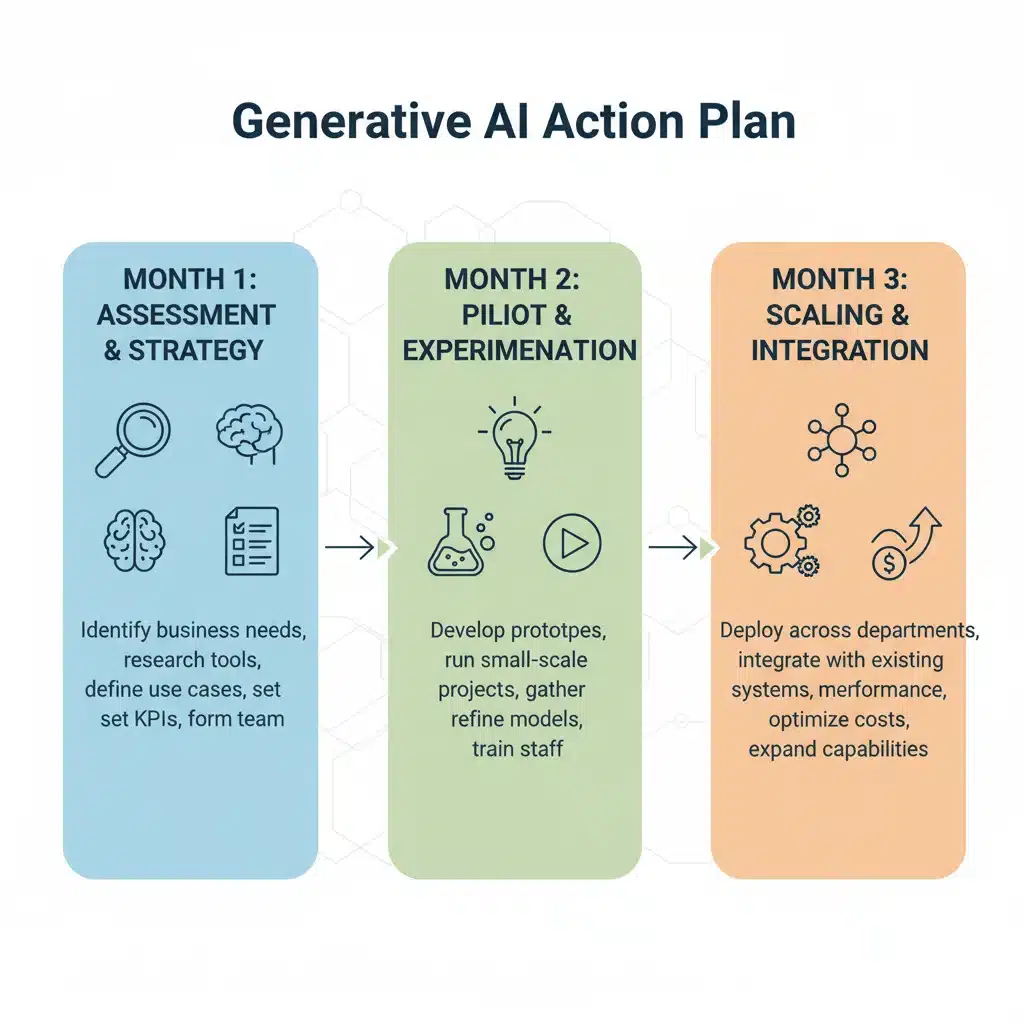
Month 1: Foundation and Strategic Assessment for Generative AI Readiness
The initial month is crucial for laying a strong foundation. This involves understanding your current state, identifying potential opportunities, and building the internal capabilities necessary to embark on your Generative AI journey. A thorough strategic assessment is paramount to ensure your efforts are aligned with your business objectives and maximize your generative AI readiness.
Week 1: Education and Awareness
- Internal Workshops and Seminars: Conduct company-wide workshops for leadership and key stakeholders to demystify Generative AI. Focus on its core concepts, capabilities, and potential impact across different departments. Invite experts to share insights on current trends and future predictions.
- Case Study Analysis: Research and analyze how early adopters in your industry (or parallel industries) are already leveraging Generative AI. Understand their successes, challenges, and lessons learned. This provides valuable context for your own generative AI readiness strategy.
- Establish an AI Task Force: Form a cross-functional team comprising representatives from IT, marketing, product development, operations, and legal. This team will be responsible for leading the Generative AI initiative, fostering collaboration, and driving generative AI readiness across the organization.
Week 2: Identify Business Use Cases
- Brainstorming Sessions: Organize dedicated brainstorming sessions with the AI Task Force and department heads. Encourage creative thinking to identify specific areas where Generative AI could add significant value. Think beyond simple automation to transformative applications.
- Prioritize Potential Applications: Evaluate identified use cases based on potential impact (e.g., cost savings, revenue generation, customer satisfaction), feasibility, and alignment with strategic goals. Focus on areas where Generative AI can solve critical pain points or unlock new opportunities, enhancing your generative AI readiness.
- Categorize by Impact: Classify use cases into categories like ‘quick wins’ (low effort, high impact), ‘strategic investments’ (higher effort, long-term impact), and ‘exploratory’ (high risk, potentially high reward). This helps in resource allocation and setting realistic expectations for generative AI readiness.
Week 3: Data Infrastructure and Governance Review
- Data Audit: Assess your existing data infrastructure. Generative AI models thrive on high-quality, well-structured data. Identify data sources, data quality issues, and gaps that need to be addressed.
- Ethical AI Framework: Develop a preliminary ethical AI framework. This should address concerns related to data privacy, bias, transparency, and accountability. Proactive ethical considerations are crucial for responsible Generative AI adoption and maintaining generative AI readiness.
- Security Assessment: Evaluate your current cybersecurity posture in the context of Generative AI. Understand potential new vulnerabilities and implement necessary safeguards to protect sensitive data and models.
Week 4: Vendor and Technology Landscape Analysis
- Research Generative AI Tools and Platforms: Explore available Generative AI tools, platforms, and APIs. Understand their capabilities, pricing models, and integration potential with your existing systems.
- Vendor Evaluation: Identify potential vendors or partners who can provide expertise, technology, or support for your Generative AI initiatives. Consider their track record, industry experience, and security protocols.
- Budget Allocation: Begin to outline a preliminary budget for Generative AI exploration, including potential software licenses, training, and consultation services. This financial planning is vital for sustainable generative AI readiness.
Month 2: Pilot Programs and Experimentation for Enhanced Generative AI Readiness
With a solid foundation in place, Month 2 shifts focus to practical application. This involves running small-scale pilot programs to test the viability of Generative AI in specific business contexts, gather insights, and refine your approach to generative AI readiness.
Week 5: Select and Define Pilot Projects
- Choose ‘Quick Wins’: Select 1-2 high-impact, low-risk use cases identified in Month 1 for pilot projects. These should be projects that can demonstrate tangible results relatively quickly.
- Define Clear Objectives and KPIs: For each pilot, establish clear, measurable objectives and Key Performance Indicators (KPIs). What specific problem are you trying to solve? How will you measure success? This ensures that your generative AI readiness efforts are quantifiable.
- Resource Allocation: Assign dedicated resources (team members, budget, tools) to each pilot project. Ensure the AI Task Force provides oversight and support.
Week 6: Data Preparation and Model Selection
- Data Cleansing and Preparation: Prepare the necessary data for your pilot projects. This often involves significant data cleansing, labeling, and formatting to meet the requirements of Generative AI models.
- Model Selection or Development: Based on your chosen use case, decide whether to utilize an off-the-shelf Generative AI model, fine-tune an existing one, or explore custom model development. Consider the trade-offs in terms of cost, time, and performance.
- API Integration Planning: If using external APIs, plan the integration points with your existing systems. Consider data flow, authentication, and error handling.
Week 7: Pilot Implementation and Testing
- Execute Pilot Projects: Begin the hands-on implementation of your pilot projects. This includes setting up the Generative AI environment, integrating with data sources, and configuring the models.
- Iterative Testing and Refinement: Continuously test the Generative AI outputs. Gather feedback from end-users, identify areas for improvement, and iterate on model parameters or data inputs. This agile approach is critical for effective generative AI readiness.
- Performance Monitoring: Implement monitoring tools to track the performance of the Generative AI models against your defined KPIs. Look for accuracy, efficiency, and user satisfaction.
Week 8: Gather Feedback and Analyze Results
- Collect User Feedback: Conduct surveys, interviews, and focus groups with individuals who interacted with the Generative AI pilot. Understand their experience, identify pain points, and gather suggestions for improvement.
- Analyze Pilot Outcomes: Evaluate the pilot projects against their initial objectives and KPIs. Document successes, failures, unexpected outcomes, and key learnings.
- Cost-Benefit Analysis: Perform a preliminary cost-benefit analysis for each pilot project. Quantify the value generated and the resources consumed. This informs future investment decisions and strengthens your generative AI readiness.
Month 3: Scaling, Integration, and Future-Proofing for Generative AI Readiness
The final month focuses on leveraging the insights from your pilot programs to develop a broader Generative AI strategy, plan for wider integration, and ensure your business is positioned for continuous innovation and generative AI readiness.
Week 9: Strategic Review and Roadmap Development
- Review Pilot Learnings: Present the results of your pilot projects to leadership and key stakeholders. Highlight successes, discuss challenges, and articulate the implications for your broader Generative AI strategy.
- Develop a Generative AI Roadmap: Based on the pilot outcomes and your initial strategic assessment, develop a phased roadmap for wider Generative AI adoption. This roadmap should outline short-term, medium-term, and long-term initiatives, with clear milestones and resource requirements.
- Refine Ethical Guidelines: Incorporate learnings from the pilot projects into your ethical AI framework. Address any new ethical considerations that emerged during experimentation.
Week 10: Talent Development and Organizational Change Management
- Upskilling and Reskilling Programs: Identify the new skills required for a Generative AI-driven future. Develop training programs to upskill your existing workforce in areas like prompt engineering, AI model interpretation, and ethical AI usage.
- Talent Acquisition Strategy: Plan for acquiring new talent with specialized Generative AI expertise if internal upskilling cannot meet all needs.
- Change Management Strategy: Develop a comprehensive change management plan to address potential resistance, communicate the benefits of Generative AI, and ensure a smooth transition for employees. This is crucial for successful generative AI readiness.

Week 11: Infrastructure Planning and Scalability
- Scalable Infrastructure Design: Plan for the necessary IT infrastructure upgrades to support broader Generative AI deployment. This might include cloud computing resources, specialized hardware (e.g., GPUs), and robust data pipelines.
- Integration Strategy: Develop a detailed integration strategy for embedding Generative AI capabilities into your core business systems and applications. Consider APIs, microservices, and existing software ecosystems.
- Security and Compliance: Reinforce your security protocols and ensure compliance with relevant industry regulations and data privacy laws (e.g., GDPR, CCPA) as you scale your Generative AI initiatives.
Week 12: Communication and Continuous Improvement
- Internal Communication Plan: Communicate the Generative AI roadmap and its benefits to all employees. Foster an environment of curiosity and continuous learning.
- External Communication Strategy: Consider how you will communicate your Generative AI efforts to customers, partners, and the market. Highlight your commitment to innovation and responsible AI use.
- Establish a Feedback Loop: Implement mechanisms for ongoing feedback, performance monitoring, and iterative improvement of your Generative AI applications. The Generative AI landscape is constantly evolving, so continuous adaptation is key to maintaining generative AI readiness.
- Stay Updated: Dedicate resources to continuously monitor advancements in Generative AI technology, emerging best practices, and regulatory changes.
Key Considerations for US Businesses in Generative AI Adoption
Beyond the 3-month plan, several overarching considerations are critical for US businesses embracing Generative AI:
Data Privacy and Security
US businesses operate under a complex web of data privacy regulations, including state-specific laws like the CCPA and industry-specific regulations (e.g., HIPAA for healthcare). Generative AI models often require vast amounts of data for training, raising concerns about how this data is collected, stored, and used. Ensuring compliance, implementing robust data anonymization techniques, and maintaining transparency with customers are paramount. The risk of data breaches or misuse of generated content necessitates a proactive and stringent security posture. Businesses must invest in secure infrastructure, conduct regular security audits, and establish clear data governance policies to protect sensitive information and maintain trust. This is a non-negotiable aspect of generative AI readiness.
Ethical AI and Bias Mitigation
Generative AI models are trained on existing data, which can inadvertently contain societal biases. If not properly addressed, these biases can be amplified in the generated outputs, leading to discriminatory outcomes, reputational damage, and legal repercussions. US businesses must prioritize ethical AI development, implement bias detection and mitigation strategies, and ensure fairness and transparency in their AI applications. This includes diverse training data, rigorous testing, and human oversight. Establishing an internal ethics committee or consulting with AI ethics experts can help navigate these complex issues and ensure responsible generative AI readiness.
Intellectual Property and Copyright
The creation of new content by Generative AI raises significant questions regarding intellectual property ownership and copyright. Who owns the content generated by an AI? Can AI-generated content infringe on existing copyrights? These are evolving legal areas, and US businesses need to stay informed about legal precedents and best practices. Developing clear policies for the use of AI-generated content, attributing sources where necessary, and understanding the legal implications of using publicly available models or data are crucial steps in managing IP risks and enhancing generative AI readiness.
Workforce Transformation and Skill Gaps
Generative AI will undoubtedly transform job roles, automating some tasks while creating new ones. US businesses must proactively address workforce transformation through strategic upskilling and reskilling initiatives. Investing in training programs that equip employees with AI literacy, prompt engineering skills, and the ability to collaborate with AI tools will be vital. Beyond technical skills, fostering critical thinking, creativity, and problem-solving abilities will become even more important. A clear communication strategy about the role of AI in the workplace can alleviate employee concerns and facilitate a smoother transition, contributing positively to generative AI readiness.
Regulatory Landscape
The regulatory environment for AI in the US is still developing, with various federal and state initiatives underway. Businesses need to monitor these developments closely, as new laws and guidelines could impact how Generative AI is developed, deployed, and used. Engaging with industry associations, legal counsel, and government relations teams can help businesses anticipate and adapt to regulatory changes, ensuring compliance and robust generative AI readiness. Proactive engagement can also provide opportunities to contribute to the shaping of future AI policies.
Conclusion: Embracing the Generative AI Future
The advent of Generative AI by 2026 presents both immense opportunities and significant challenges for US businesses. By following this structured 3-month action plan, companies can systematically assess their current state, experiment with pilot programs, and strategically plan for broader integration. The journey to generative AI readiness is not a one-time event but an ongoing process of learning, adaptation, and innovation.
Proactive engagement, coupled with a strong emphasis on ethical considerations, data security, and workforce development, will be the hallmarks of successful organizations. Those that embrace Generative AI with foresight and a well-executed strategy will not only navigate the coming changes but will emerge as leaders, redefining their industries and creating new value in the digital economy. The time to act for generative AI readiness is now – don’t let your business be caught unprepared for the transformative power of Generative AI.