Refinance Mortgage 2026: 0.5% Rate Drop Impact on Payments
Financial Impact: Refinancing Your Mortgage in 2026: What a 0.5% Rate Drop Means for Your Monthly Payments
As we navigate the ever-evolving landscape of personal finance, one area that consistently captures the attention of homeowners is their mortgage. For many, a mortgage represents their largest monthly expense and their most significant long-term financial commitment. Therefore, any shift in interest rates, even a seemingly small one, can have profound implications. This is particularly true when considering the prospect of refinancing. With 2026 on the horizon, discussions about potential economic shifts and interest rate adjustments are already gaining traction. Specifically, the question on many homeowners’ minds is: what would a 0.5% rate drop mean for my monthly mortgage payments, and should I consider a mortgage refinance 2026?
This comprehensive guide will delve into the intricacies of mortgage refinancing, specifically analyzing the financial impact of a 0.5% interest rate reduction in 2026. We’ll explore the mechanisms behind such a drop, the potential savings homeowners could realize, and the strategic considerations necessary to make an informed decision about a mortgage refinance 2026. Whether you’re a seasoned homeowner or relatively new to the mortgage market, understanding these dynamics is crucial for optimizing your financial health.
Understanding Mortgage Rates and Their Fluctuations
Before we dissect the impact of a 0.5% rate drop, it’s essential to understand what drives mortgage rates. These rates are influenced by a complex interplay of economic factors, including:
- Federal Reserve Policy: While the Fed doesn’t directly set mortgage rates, its actions, particularly regarding the federal funds rate, significantly impact the broader interest rate environment. When the Fed raises or lowers its benchmark rate, it influences the cost of borrowing for banks, which in turn affects the rates they offer to consumers for mortgages.
- Inflation: Lenders typically demand higher interest rates during periods of high inflation to compensate for the eroding purchasing power of future repayments. Conversely, lower inflation can lead to lower rates.
- Economic Growth: A strong economy often correlates with higher interest rates as demand for credit increases. A slowing economy, on the other hand, might see rates decline as the Fed and lenders try to stimulate activity.
- Bond Market: Mortgage rates are closely tied to the yield on the 10-year Treasury bond. When bond yields rise, mortgage rates tend to follow suit, and vice versa.
- Housing Market Conditions: Supply and demand in the housing market, as well as the overall health of the real estate sector, can also play a role in influencing mortgage rates.
Forecasting interest rates is notoriously difficult, but economists and financial institutions constantly analyze these indicators to predict future trends. The anticipation of a 0.5% drop in 2026 suggests a potential shift towards a more accommodative monetary policy or a response to changing economic forecasts. For homeowners, this prediction opens a window of opportunity for a mortgage refinance 2026.
The Basics of Mortgage Refinancing
Refinancing essentially means replacing your existing mortgage with a new one. Homeowners typically refinance for several reasons:
- Lower Interest Rate: This is the most common reason, as a lower rate can significantly reduce monthly payments and the total interest paid over the life of the loan.
- Reduce Loan Term: Some homeowners refinance to a shorter loan term (e.g., from a 30-year to a 15-year mortgage) to pay off their home faster, often securing a lower interest rate in the process.
- Cash-Out Refinance: This allows homeowners to tap into their home equity, converting it into cash for various needs like home improvements, debt consolidation, or other large expenses.
- Change Loan Type: Switching from an adjustable-rate mortgage (ARM) to a fixed-rate mortgage for stability, or vice versa if market conditions are favorable.
- Remove PMI: If you’ve built up sufficient equity, refinancing might allow you to eliminate private mortgage insurance (PMI), further reducing your monthly costs.
A mortgage refinance 2026 scenario with a 0.5% rate drop primarily focuses on the first benefit – securing a lower interest rate. Even a seemingly small percentage point can translate into substantial savings over time.
Quantifying the Impact: A 0.5% Rate Drop
Let’s get down to the numbers. How much can a 0.5% interest rate drop actually save you? The exact savings will depend on several factors: your current mortgage balance, your existing interest rate, and the remaining term of your loan. However, we can illustrate the potential impact with some examples.
Example Scenario 1: Standard 30-Year Fixed Mortgage
Consider a homeowner with an original mortgage of $300,000, 25 years remaining, and a current interest rate of 6.0%.
- Current Monthly Payment: Approximately $1,932
If they refinance to a new 30-year fixed mortgage at 5.5% (a 0.5% drop):
- New Monthly Payment: Approximately $1,703
- Monthly Savings: $1,932 – $1,703 = $229
- Annual Savings: $229 x 12 = $2,748
- Total Savings Over 30 Years (assuming new 30-year term): $229 x 360 = $82,440
This example clearly demonstrates that a 0.5% drop can lead to significant monthly and long-term savings, making a mortgage refinance 2026 a very attractive option.
Example Scenario 2: Larger Mortgage Balance
Now, let’s consider a homeowner with a larger balance, say $500,000, 20 years remaining, and a current interest rate of 5.0%.
- Current Monthly Payment: Approximately $3,300
If they refinance to a new 20-year fixed mortgage at 4.5% (a 0.5% drop):
- New Monthly Payment: Approximately $3,163
- Monthly Savings: $3,300 – $3,163 = $137
- Annual Savings: $137 x 12 = $1,644
While the percentage of savings might seem less dramatic on a shorter term, the absolute dollar amount is still considerable. The key takeaway is that the higher your outstanding mortgage balance, the greater the absolute dollar savings from even a small rate reduction. This makes the prospect of a mortgage refinance 2026 even more compelling for those with substantial loan amounts.
Long-Term Interest Savings
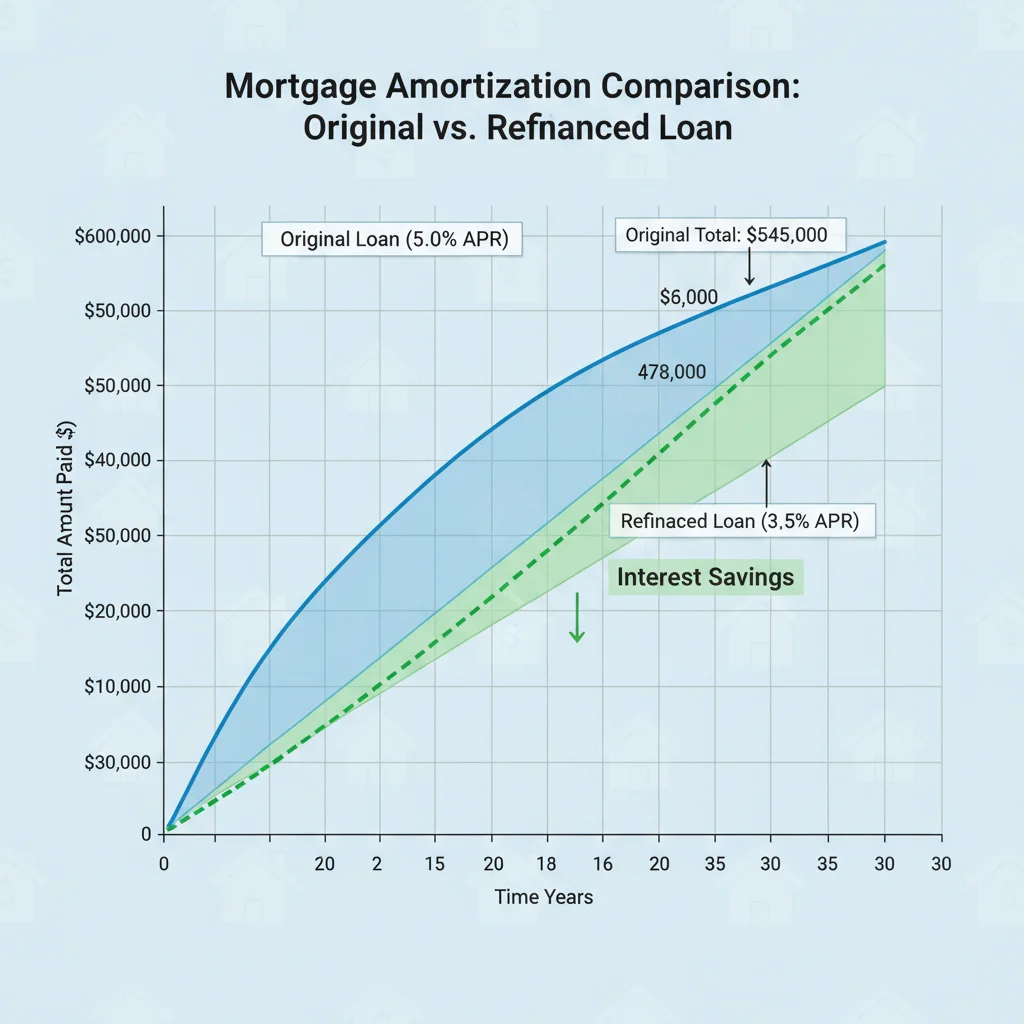
Beyond monthly payments, a lower interest rate significantly reduces the total amount of interest you pay over the life of the loan. This is often the most substantial benefit of refinancing. By reducing the interest rate by 0.5%, you’re effectively paying less for the money you borrowed, freeing up capital that can be used for other financial goals, such as retirement savings, investments, or education funds.

Factors to Consider Before a Mortgage Refinance 2026
While the potential savings from a 0.5% rate drop are enticing, refinancing isn’t a universally beneficial decision. Several factors need careful consideration:
1. Closing Costs
Refinancing involves closing costs, similar to when you first purchased your home. These can include appraisal fees, origination fees, title insurance, attorney fees, and more. Closing costs typically range from 2% to 5% of the loan amount. You need to calculate if the savings from the lower interest rate will outweigh these upfront costs within a reasonable timeframe (the ‘break-even point’).
For example, if your closing costs are $6,000 and you save $200 per month, your break-even point is 30 months ($6,000 / $200). If you plan to stay in your home longer than this, refinancing is likely a good idea. If you anticipate moving sooner, the costs might negate the benefits.
2. How Long You Plan to Stay in Your Home
As mentioned above, the break-even point is crucial. If you’re planning to sell your home in the near future, the cost of refinancing might not be recouped by the monthly savings. A mortgage refinance 2026 should align with your long-term housing plans.
3. Your Credit Score
Lenders offer the best interest rates to borrowers with excellent credit scores. Before pursuing a mortgage refinance 2026, check your credit report and score. If your score has improved since you first took out your mortgage, you’re in a stronger position to secure a favorable new rate. Conversely, a significantly lower credit score could mean you won’t qualify for the advertised best rates, or even for a refinance at all.
4. Home Equity
Lenders typically require a certain amount of equity in your home to approve a refinance. Generally, you’ll need at least 20% equity to avoid private mortgage insurance (PMI) on a conventional refinance. If your home’s value has decreased or you haven’t paid down much of your principal, you might have limited equity, which could impact your eligibility or the terms of your new loan.
5. The New Loan Term
When you refinance, you’re essentially starting a new loan term. If you’ve already paid down a significant portion of your original 30-year mortgage, refinancing into another 30-year term might mean paying interest for a longer overall period, even with a lower rate. Consider a shorter loan term (e.g., 15-year fixed) if financially feasible, as this can lead to substantial interest savings despite higher monthly payments.
6. Current Economic Outlook for 2026
While a 0.5% rate drop is a positive indicator, it’s vital to stay informed about the broader economic outlook for 2026. What are the projections for inflation, unemployment, and economic growth? These factors will influence whether the anticipated rate drop materializes and if it’s sustained. A dynamic financial environment requires a flexible approach to planning a mortgage refinance 2026.
Steps to Prepare for a Mortgage Refinance 2026
If the prospect of a 0.5% rate drop and the potential for a mortgage refinance 2026 sounds appealing, here are some preparatory steps you can take:
1. Monitor Interest Rates
Stay informed about current mortgage rates and economic forecasts. Financial news outlets, mortgage lender websites, and financial advisors can provide valuable insights into market trends. Set up alerts for rate changes that could trigger your refinance decision.
2. Review Your Credit Report
Obtain free copies of your credit report from all three major bureaus (Equifax, Experian, and TransUnion) at AnnualCreditReport.com. Check for any errors and take steps to improve your credit score if necessary. A higher score will open doors to better rates for your mortgage refinance 2026.
3. Organize Your Financial Documents
Gather essential documents that lenders will require, such as pay stubs, W-2s, tax returns, bank statements, and current mortgage statements. Having these readily available will streamline the application process.
4. Calculate Your Break-Even Point
Use online refinance calculators or consult with a financial advisor to estimate your potential savings and the break-even point for various scenarios. This will help you determine if a mortgage refinance 2026 is financially sensible for your unique situation.
5. Shop Around for Lenders
Don’t settle for the first offer you receive. Contact multiple lenders – banks, credit unions, and online mortgage companies – to compare rates, fees, and terms. Even small differences can add up to significant savings over time. Each lender might have different underwriting criteria, so exploring various options is key to securing the best deal for your mortgage refinance 2026.
6. Understand Different Refinance Options
Beyond just a lower rate, consider if a cash-out refinance, a shorter term, or switching loan types (e.g., from FHA to conventional) aligns better with your financial goals. A mortgage refinance 2026 could be an opportunity to completely restructure your home loan to better suit your current and future needs.
Potential Risks and Downsides of Refinancing
While the benefits are clear, it’s also important to be aware of the potential risks associated with refinancing:
- Restarting the Loan Term: As mentioned, if you refinance a 30-year mortgage 10 years in, into a new 30-year mortgage, you’re extending the period over which you pay interest. Even with a lower rate, this could mean paying more interest overall if not managed carefully.
- Closing Costs: These are a direct out-of-pocket expense that can be substantial. If you roll them into your new loan, you’ll be paying interest on them for the life of the loan.
- Impact on Credit Score: Applying for a new mortgage involves a hard inquiry on your credit report, which can temporarily lower your score by a few points. Multiple applications within a short period could have a more significant impact, though credit scoring models often treat multiple mortgage inquiries within a 14-45 day window as a single inquiry.
- Loss of Mortgage Insurance: If you had a conventional loan and were close to dropping PMI, refinancing might reset that timeline, especially if your new loan amount is higher relative to your home’s value.
- Prepayment Penalties: While rare with conventional mortgages, some loans (especially older or less common types) may have prepayment penalties that could make refinancing costly. Always check your current loan terms.
A thorough understanding of these potential drawbacks is essential for anyone considering a mortgage refinance 2026. Informed decisions are always the best decisions.
The Broader Economic Landscape for 2026 and Beyond
Looking ahead to 2026, several factors could contribute to a 0.5% rate drop. Central banks might shift towards easing monetary policy if inflation is brought under control and economic growth shows signs of slowing. Global economic conditions, geopolitical stability, and supply chain dynamics will also play a role. A more stable and predictable economic environment could lead to lower long-term interest rates, making a mortgage refinance 2026 a widespread opportunity.
Conversely, unforeseen economic shocks or persistent inflationary pressures could keep rates elevated or even push them higher. This highlights the importance of not just reacting to a potential rate drop but maintaining a proactive and informed approach to your financial planning. Flexibility and continuous monitoring of market conditions will be key if you’re targeting a mortgage refinance 2026.
Conclusion: Is a Mortgage Refinance 2026 Right for You?
The prospect of a 0.5% interest rate drop in 2026 presents a significant opportunity for many homeowners to reduce their monthly mortgage payments and save tens of thousands of dollars over the life of their loan. While the allure of lower payments is strong, the decision to pursue a mortgage refinance 2026 should be based on a careful analysis of your personal financial situation, including your credit score, home equity, the length of time you plan to stay in your home, and the associated closing costs.
By understanding the mechanics of mortgage rates, calculating potential savings, and diligently preparing for the refinancing process, you can position yourself to take full advantage of favorable market conditions. Consult with a qualified financial advisor or mortgage professional to discuss your specific circumstances and determine if a mortgage refinance 2026 aligns with your long-term financial goals. Staying informed and proactive will be your best strategy in navigating the financial landscape of the coming years.