
Navigating the Ethical Labyrinth: A 2026 Comparison of US AI Ethics Frameworks
The rapid acceleration of Artificial Intelligence (AI) development has undeniably ushered in an era of unprecedented innovation and transformative potential. From revolutionizing healthcare and transportation to enhancing economic productivity, AI’s influence permeates nearly every facet of modern society. However, this progress is not without its complexities. As AI systems become more sophisticated and autonomous, so too do the ethical dilemmas they present. Questions of bias, transparency, accountability, and privacy are no longer hypothetical considerations but urgent challenges demanding robust and actionable solutions. In response, a diverse array of organizations, from government bodies and industry giants to academic institutions and non-profits, have been diligently working to establish comprehensive AI ethics frameworks. These frameworks aim to guide the responsible design, development, and deployment of AI, ensuring that technological advancement aligns with societal values and human well-being.
As we look towards 2026, the landscape of AI ethics in the United States is more dynamic and critical than ever. The initial enthusiasm for AI has matured into a more nuanced understanding of its implications, prompting a concentrated effort to standardize ethical practices. This article provides an in-depth comparison of the leading AI ethics frameworks currently influencing US AI development. We will delve into their core principles, assess their practical implementation strategies, and evaluate their effectiveness in fostering responsible AI. By dissecting these frameworks, we aim to offer clarity on the current state of AI ethics, highlight emerging trends, and provide insights into the future trajectory of ethical AI governance.
Understanding these frameworks is not merely an academic exercise; it is an imperative for anyone involved in the AI ecosystem. Developers, policymakers, business leaders, and consumers alike stand to benefit from a clear grasp of the ethical guidelines shaping the future of AI. The decisions made today regarding AI ethics will have profound and lasting impacts on the trust, fairness, and safety of AI systems for generations to come. This comparative analysis will serve as a valuable resource for navigating the intricate ethical landscape of AI in the US, empowering stakeholders to make informed choices and contribute to a more ethically sound AI future.
The Imperative for AI Ethics Frameworks in 2026
The urgency for well-defined AI ethics frameworks stems from several critical factors that have become increasingly prominent by 2026. Firstly, the sheer scale and pervasiveness of AI applications mean that even minor ethical missteps can have widespread consequences. From algorithmic bias impacting hiring decisions and loan applications to autonomous systems making life-or-death choices, the potential for harm is significant. Without clear ethical guidelines, there is a risk of exacerbating existing societal inequalities, eroding public trust, and undermining the very benefits AI promises.
Secondly, the rapid pace of technological innovation often outstrips the ability of traditional regulatory bodies to keep pace. Frameworks provide a proactive mechanism for guiding development, offering principles and best practices that can adapt more quickly than formal legislation. They serve as a crucial bridge between technological capability and societal expectation, helping to shape a responsible trajectory for AI.
Thirdly, the global nature of AI development necessitates a degree of alignment, or at least understanding, across different jurisdictions. While this article focuses on US frameworks, many of the underlying ethical principles resonate internationally. Establishing robust domestic frameworks can also position the US as a leader in responsible AI, influencing global standards and fostering international cooperation on critical ethical challenges.
Finally, and perhaps most importantly, public trust in AI is paramount for its continued adoption and success. Incidents of AI misuse or ethical failures can quickly erode this trust, leading to public skepticism and resistance. Comprehensive AI ethics frameworks demonstrate a commitment to responsible innovation, reassuring the public that AI is being developed with their best interests at heart. They provide a foundation for accountability, offering mechanisms to address concerns and rectify issues when they arise. In essence, these frameworks are not just about preventing harm; they are about building a sustainable and beneficial future for AI, one that is rooted in ethical principles and societal trust. By 2026, it is clear that the absence of such frameworks would not only be irresponsible but also economically and socially detrimental, hindering AI’s potential rather than unleashing it.
Key Pillars of Modern AI Ethics: Common Ground Across Frameworks
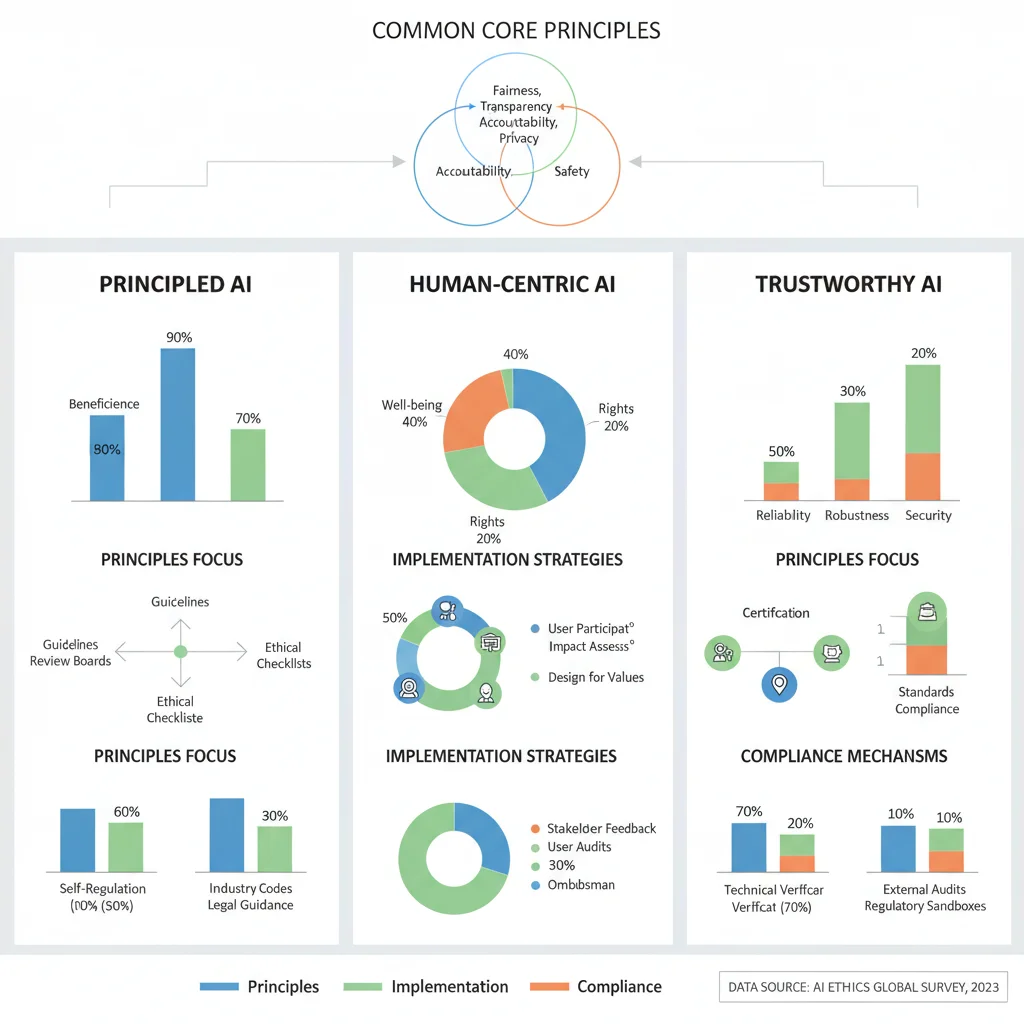
Despite the diversity in their origins and specific recommendations, most leading AI ethics frameworks in the US coalesce around a core set of fundamental principles. These pillars serve as the bedrock upon which responsible AI development and deployment are built. Understanding these commonalities is crucial for appreciating the broader ethical consensus emerging within the AI community.
1. Fairness and Non-Discrimination:
This principle is perhaps the most frequently discussed and critically important. It mandates that AI systems should be designed and deployed in a way that avoids creating or reinforcing unfair biases, discrimination, or disparate impacts on individuals or groups. This includes addressing algorithmic bias in data collection, model training, and decision-making processes. Frameworks often emphasize the need for rigorous testing, auditing, and mitigation strategies to ensure equitable outcomes, particularly in sensitive areas like employment, credit, and criminal justice.
2. Transparency and Explainability:
As AI models become more complex, their decision-making processes can become opaque, often referred to as the “black box” problem. Transparency and explainability require that AI systems, and the rationale behind their outputs, should be understandable to humans. This doesn’t necessarily mean revealing every line of code, but rather providing sufficient clarity on how the system operates, what data it uses, and why it arrived at a particular conclusion. This principle is vital for accountability, allowing users and stakeholders to understand, challenge, and trust AI-driven decisions.
3. Accountability and Responsibility:
Who is responsible when an AI system makes a mistake or causes harm? This principle addresses the need to clearly define lines of accountability for the design, development, deployment, and oversight of AI systems. Frameworks typically advocate for human oversight, robust governance structures, and mechanisms for recourse and redress when AI systems cause adverse impacts. It emphasizes that ultimate responsibility for AI’s actions rests with human developers, deployers, and operators, not the AI itself.
4. Privacy and Data Governance:
AI systems are often data-intensive, making robust privacy protections and sound data governance paramount. This principle emphasizes the ethical collection, storage, use, and sharing of personal data, aligning with existing privacy regulations like GDPR (where applicable) and emerging US state-level privacy laws. Frameworks call for data minimization, anonymization techniques, robust security measures, and respect for individual data rights and consent. Ensuring that AI development does not compromise individual privacy is a foundational ethical requirement.
5. Safety and Reliability:
AI systems, especially those operating in critical domains, must be safe, robust, and reliable. This principle demands rigorous testing, validation, and continuous monitoring to ensure that AI systems function as intended, are secure against malicious attacks, and do not pose undue risks to human life or well-being. It encompasses considerations of system robustness, resilience to adversarial attacks, and the ability to handle unexpected situations gracefully.
6. Human Oversight and Control:
While AI can automate many tasks, the principle of human oversight ensures that humans remain in ultimate control. This can range from ‘human-in-the-loop’ systems where humans make final decisions, to ‘human-on-the-loop’ systems where humans monitor AI performance and intervene when necessary. The goal is to prevent full autonomy in critical decision-making contexts and maintain human agency and ethical judgment.
These six pillars form a strong ethical foundation, guiding the development of responsible AI. While the specific interpretations and implementation strategies may vary across different AI ethics frameworks, their presence as core tenets underscores a growing consensus on what constitutes ethical AI in the US and globally. The challenge, and indeed the focus of many frameworks, lies in translating these high-level principles into practical, actionable guidelines for the entire AI lifecycle.
Leading US AI Ethics Frameworks in 2026: A Comparative Analysis
By 2026, several prominent AI ethics frameworks have emerged in the US, each contributing a unique perspective and approach to responsible AI. While they share common ethical pillars, their scope, target audience, and implementation mechanisms often differ. Here, we compare some of the most influential frameworks.
1. The NIST AI Risk Management Framework (AI RMF):
Origin and Scope: Developed by the National Institute of Standards and Technology (NIST), the AI RMF is a voluntary framework designed for broad use across the AI lifecycle. It provides a flexible, risk-based approach to managing the trustworthiness of AI systems. It’s not a regulatory document but rather a practical guide for organizations to identify, assess, and mitigate risks associated with AI.
Key Principles/Focus: The AI RMF emphasizes a continuous cycle of Govern, Map, Measure, and Manage. It focuses heavily on identifying AI risks (e.g., bias, privacy violations, security vulnerabilities), establishing clear governance structures, developing methods to measure and evaluate AI system performance against ethical criteria, and implementing strategies to manage and mitigate identified risks. Its strength lies in its actionable nature, providing specific guidance rather than just abstract principles.
Target Audience: AI developers, deployers, risk managers, policymakers, and organizations across all sectors.
Strengths: Highly practical, adaptable, and focused on risk management. It provides a structured approach for organizations to operationalize AI ethics. Its voluntary nature encourages broad adoption.
Weaknesses: Being voluntary, its adoption is not mandatory, and its effectiveness relies on organizational commitment. It doesn’t prescribe specific technical solutions.
2. The Office of Science and Technology Policy (OSTP) Blueprint for an AI Bill of Rights:
Origin and Scope: Released by the White House Office of Science and Technology Policy (OSTP), the AI Bill of Rights is a set of five core principles and associated practices designed to guide the design, use, and deployment of automated systems to protect the American public in the age of artificial intelligence. It focuses on protecting individual rights and liberties.
Key Principles/Focus: The five principles are: Safe and Effective Systems; Algorithmic Discrimination Protections; Data Privacy; Notice and Explanation; and Human Alternatives, Consideration, and Fallback. It prioritizes the protection of individuals from harmful AI impacts, particularly concerning civil rights and liberties. It advocates for robust safeguards against discrimination, clear explanations of AI decisions, and human oversight.
Target Audience: Policymakers, developers, and organizations whose AI systems impact the public, particularly those in critical sectors like healthcare, finance, and criminal justice.
Strengths: Strong emphasis on individual rights and protections, providing a clear ethical compass for AI development. It highlights the importance of public trust and democratic values in AI.
Weaknesses: As a blueprint, it currently lacks direct regulatory power, serving more as a guiding document for future policy. Its implementation relies on subsequent legislation or industry adoption.

3. Industry-Specific AI Ethics Guidelines (e.g., Google, IBM, Microsoft):
Origin and Scope: Major tech companies have developed their own internal and often publicly shared AI ethics frameworks. These frameworks are typically driven by a combination of corporate social responsibility, risk mitigation, and a desire to shape industry standards. They often address ethical considerations specific to their products and services.
Key Principles/Focus: While varying in detail, these often include principles like fairness, transparency, accountability, privacy, safety, and human-centered design. For instance, Google’s AI Principles emphasize beneficial AI, avoiding bias, building and testing for safety, and being accountable to people. IBM’s principles focus on purpose, transparency, and skills. Microsoft’s Responsible AI principles include fairness, reliability & safety, privacy & security, inclusiveness, transparency, and accountability.
Target Audience: Internal development teams, partners, and the broader AI industry seeking best practices.
Strengths: Offers practical insights from leading AI developers, often leading to toolkits and operational guidelines. They can set a high bar for responsible development within specific companies and influence broader industry practices.
Weaknesses: Can be perceived as self-regulatory, potentially lacking the independent oversight of governmental frameworks. Their implementation and enforcement can vary significantly across organizations, and they may not cover all potential societal impacts.
4. Academic and Non-Profit Initiatives (e.g., Partnership on AI, AI Now Institute):
Origin and Scope: These frameworks often emerge from multi-stakeholder collaborations, bringing together academics, civil society organizations, industry experts, and government representatives. They typically focus on research, advocacy, and developing consensus-driven ethical guidelines.
Key Principles/Focus: These initiatives often delve deeper into specific ethical challenges, such as the societal impact of AI, algorithmic justice, and democratic governance of AI. For example, the Partnership on AI’s ‘About ML’ initiative focuses on transparency in machine learning models, while the AI Now Institute often highlights the social and political implications of AI, advocating for stronger regulations and public accountability.
Target Audience: Policymakers, researchers, civil society, and the general public.
Strengths: Provide critical, independent perspectives, often highlighting ethical blind spots or under-addressed issues. They foster interdisciplinary dialogue and contribute significantly to public discourse on AI ethics.
Weaknesses: Primarily influential through advocacy and research; they typically lack direct implementation power. Their recommendations may be more theoretical or aspirational without direct enforcement mechanisms.
This comparison reveals a multi-faceted approach to AI ethics frameworks in the US by 2026. While governmental initiatives like NIST and OSTP aim to provide overarching guidance and protect public interests, industry leaders are operationalizing ethics within their development pipelines. Meanwhile, academic and non-profit organizations continue to push the boundaries of ethical discourse, ensuring that critical societal concerns remain at the forefront. The interplay between these different types of frameworks is crucial for building a comprehensive and resilient ethical infrastructure for AI.
Operationalizing AI Ethics: From Principles to Practice
The true test of any AI ethics framework lies not just in its well-articulated principles but in its practical implementation. By 2026, the focus has increasingly shifted from merely defining ethical guidelines to developing concrete strategies for operationalizing them throughout the AI lifecycle. This involves integrating ethical considerations into every stage, from initial conception and data collection to model deployment and ongoing monitoring.
Ethical AI by Design:
A key trend is the adoption of ‘Ethics by Design’ or ‘Responsible AI by Design’ principles. This means embedding ethical considerations from the very outset of an AI project, rather than attempting to bolt them on as an afterthought. This includes:
- Ethical Impact Assessments (EIAs): Conducting thorough assessments to identify potential ethical risks, biases, and societal impacts before development begins. This mirrors traditional privacy impact assessments but with a broader ethical scope.
- Diverse and Representative Data: Proactively seeking and utilizing diverse and representative datasets to minimize algorithmic bias. This also involves careful consideration of data provenance, consent, and privacy.
- Human-Centered Design: Designing AI systems with human values, well-being, and control at the forefront. This involves user testing, feedback loops, and ensuring that AI augments, rather than diminishes, human capabilities and autonomy.
Governance and Accountability Mechanisms:
Effective operationalization requires robust governance structures and clear lines of accountability. Many organizations are establishing:
- AI Ethics Boards/Committees: Cross-functional teams comprising ethicists, engineers, legal experts, and business leaders to provide oversight, guidance, and review of AI projects.
- Ethical AI Toolkits and Playbooks: Developing practical tools, templates, and guidelines to help developers and project managers integrate ethical considerations into their daily workflows.
- Auditing and Certification: Implementing internal and potentially external auditing processes to verify compliance with ethical principles and framework guidelines. The emergence of ‘ethical AI certification’ is also a growing area of interest.
Education and Training:
A critical component of operationalizing AI ethics frameworks is ensuring that all personnel involved in AI development and deployment are adequately trained and aware of their ethical responsibilities. This includes:
- Mandatory Ethics Training: Implementing regular training programs for engineers, data scientists, product managers, and leadership on AI ethics principles, potential risks, and mitigation strategies.
- Fostering an Ethical Culture: Creating an organizational culture that values ethical considerations as highly as technical performance, encouraging open discussion and reporting of ethical concerns.
Continuous Monitoring and Iteration:
AI systems are not static; they evolve over time. Therefore, ethical considerations must also be continuous. This involves:
- Post-Deployment Monitoring: Continuously monitoring deployed AI systems for unintended biases, performance drifts, and new ethical concerns that may emerge in real-world usage.
- Feedback Loops and Remediation: Establishing mechanisms for users and stakeholders to report issues, and processes for quickly investigating and remediating ethical problems.
- Framework Evolution: Recognizing that AI ethics is an evolving field, frameworks themselves must be regularly reviewed and updated to address new technological capabilities and societal challenges.
The journey from abstract ethical principles to actionable practices is complex and ongoing. However, by 2026, there is a clear and concerted effort across various sectors to embed AI ethics frameworks deeply into the operational fabric of AI development, moving towards a future where responsible AI is not just an aspiration but a standard practice.
Challenges and Future Directions for US AI Ethics Frameworks
While significant progress has been made in establishing AI ethics frameworks in the US by 2026, several challenges persist, and new directions are emerging. Addressing these will be crucial for the continued evolution and effectiveness of responsible AI governance.
1. The Enforcement Gap:
One of the primary challenges is moving beyond voluntary guidelines to enforceable standards. While frameworks like NIST’s AI RMF provide excellent guidance, their voluntary nature means that adherence is not guaranteed. The OSTP’s AI Bill of Rights lays a foundation, but without legislative backing, its impact remains aspirational. The future will likely see increased pressure for more binding regulations, potentially at both federal and state levels, to ensure universal adoption of core ethical principles.
2. Interoperability and Harmonization:
With multiple frameworks originating from different sources (government, industry, academia), there’s a risk of fragmentation and conflicting guidance. Organizations operating across different sectors or globally may struggle with complying with a patchwork of requirements. A future direction will be to seek greater interoperability and harmonization among frameworks, perhaps through meta-standards or cross-referencing mechanisms, to reduce the burden on implementers and foster a more coherent ethical landscape.
3. Technical Implementation Challenges:
Translating high-level ethical principles into concrete technical solutions remains a significant hurdle. For instance, achieving ‘explainability’ for highly complex neural networks is an active area of research. Developing robust methods for bias detection and mitigation, ensuring privacy-preserving AI, and building verifiable safety measures require continuous innovation in AI engineering. Future frameworks will need to integrate more deeply with technical standards and provide clearer guidance on how to operationalize ethics at the code level.
4. Global Alignment and Geopolitics:
AI development is a global endeavor, and ethical standards are not confined by national borders. While the US focuses on its domestic frameworks, there’s a growing need to engage in international dialogue and collaboration with regions like the EU (with its AI Act) and other leading AI nations. Harmonizing ethical approaches globally can prevent regulatory arbitrage and ensure a level playing field for responsible innovation, though geopolitical considerations often complicate this.
5. Addressing Emerging AI Risks:
The rapid evolution of AI means new ethical challenges are constantly surfacing. The rise of generative AI, large language models, and advanced autonomous systems introduces novel concerns related to misinformation, intellectual property, deepfakes, and the future of work. Existing frameworks will need to be agile and adaptive, regularly updating to address these emergent risks and ensure they remain relevant.
6. Public Engagement and Education:
The success of any ethical AI initiative ultimately depends on public trust and understanding. Future efforts will need to place a greater emphasis on public engagement, educating citizens about AI’s capabilities and risks, and soliciting their input on ethical guidelines. Bridging the knowledge gap between AI experts and the general public is crucial for democratic oversight and acceptance of AI technologies.
The journey of establishing comprehensive and effective AI ethics frameworks is iterative and complex. By 2026, the US has laid a strong foundation, but the path ahead requires continuous adaptation, collaboration, and a steadfast commitment to ensuring that AI serves humanity’s best interests. Addressing these challenges and pursuing these future directions will be paramount in shaping a truly responsible and beneficial AI ecosystem.
Conclusion: Towards a Mature Ethical AI Ecosystem in 2026 and Beyond
As we conclude this exploration of AI ethics frameworks in the US by 2026, it is evident that the field has matured significantly. What began as a series of abstract discussions has evolved into a concerted effort to establish practical, actionable guidelines for responsible AI development and deployment. The confluence of governmental initiatives, industry best practices, and academic insights has forged a multi-layered approach to ethical AI governance, characterized by a shared commitment to core principles such as fairness, transparency, accountability, privacy, safety, and human oversight.
The comparative analysis underscores the distinct yet complementary roles played by various stakeholders. The NIST AI RMF offers a pragmatic, risk-based methodology for operationalizing ethics, providing organizations with a flexible blueprint for internal governance. The OSTP’s AI Bill of Rights stands as a powerful declaration of individual rights in the age of AI, setting a high bar for the protection of civil liberties and democratic values. Concurrently, major tech companies have integrated ethical considerations into their product lifecycles, often leading to innovative tools and internal policies. Academic and non-profit organizations continue to act as critical watchdogs and thought leaders, pushing for deeper societal reflection and more robust regulatory interventions.
However, the journey towards a fully mature ethical AI ecosystem is far from complete. Significant challenges remain, particularly concerning the transition from voluntary guidelines to enforceable standards, the harmonization of diverse frameworks, and the continuous adaptation to emerging AI risks. The imperative for greater technical solutions to embed ethics into AI systems, alongside global alignment efforts, will define the next phase of this evolution.
Ultimately, the success of these AI ethics frameworks will be measured by their ability to foster public trust, mitigate harms, and ensure that AI serves as a force for good. By 2026, the groundwork has been laid for a future where AI innovation is not only rapid but also deeply responsible and ethically sound. The ongoing commitment of all stakeholders – from policymakers and corporations to developers and citizens – will be essential in navigating the complexities of AI and shaping a future where technology truly empowers humanity while upholding fundamental values.
The dialogue around AI ethics is dynamic and ever-evolving. Staying informed about these frameworks and actively participating in their development and refinement is crucial for anyone invested in the future of artificial intelligence. The path ahead requires vigilance, collaboration, and a shared vision for an AI-powered world that is both innovative and profoundly humane.