Explainable AI Tools 2026: Essential for US Developers

The rapid advancement of Artificial Intelligence (AI) has ushered in an era where complex algorithms drive critical decisions across industries. From healthcare diagnostics to financial trading, AI systems are increasingly integrated into the fabric of daily life. However, as AI models grow in complexity and autonomy, a new imperative has emerged: the need for transparency and understanding. This is where Explainable AI (XAI) comes into play. For US developers in 2026, understanding and implementing leading Explainable AI Tools is not just an advantage, but a necessity. The landscape of AI is shifting, demanding not only performance but also accountability, trust, and ethical considerations. Recent updates in the field underscore this urgency, pushing XAI from a niche area to a core competency for any serious AI practitioner.
The concept of a ‘black box’ AI, where decisions are made without clear rationale, is becoming increasingly untenable. Regulatory bodies, consumers, and even fellow developers are demanding insights into how AI models arrive at their conclusions. This demand is fueled by the need for debugging, auditing, ensuring fairness, and building trust. Imagine an AI system denying a loan application or flagging a medical diagnosis without any ability to explain why. Such scenarios highlight the critical role of Explainable AI Tools in mitigating risks and fostering responsible AI development. This comprehensive guide will delve into the rise of XAI, its foundational principles, and spotlight four critical Explainable AI Tools that US developers must prioritize by 2026, incorporating the latest advancements and practical applications.
The Imperative of Explainable AI: Why Now?
The journey towards robust and trustworthy AI systems is paved with challenges, chief among them being the inherent opaqueness of many advanced machine learning models. Deep neural networks, for instance, can achieve remarkable accuracy but often operate as ‘black boxes,’ making it difficult for humans to understand their internal workings or the rationale behind their predictions. This lack of transparency poses significant problems, particularly in high-stakes domains.
Consider the legal and ethical implications. If an AI system makes a biased decision, how can we identify the source of that bias without understanding its decision-making process? Regulatory frameworks, such as the EU’s General Data Protection Regulation (GDPR) and emerging US state-level AI regulations, are increasingly mandating a ‘right to explanation’ concerning automated decisions. This legal pressure alone makes mastery of Explainable AI Tools indispensable.
Beyond compliance, the practical benefits for developers are immense. XAI enhances model debugging and refinement. When a model performs unexpectedly, explainability techniques can pinpoint which features or interactions are driving erroneous predictions, allowing developers to iterate and improve their models more efficiently. It also fosters user trust. When users understand why an AI system made a particular recommendation or decision, they are more likely to accept and rely on its output. This human-AI collaboration is crucial for successful AI adoption across various sectors.
Moreover, XAI plays a pivotal role in identifying and mitigating algorithmic bias. By explaining how features contribute to predictions, developers can detect if models are relying on discriminatory attributes, even unintentionally, and take corrective action. This is vital for building fair and equitable AI systems that benefit all segments of society. The demand for Explainable AI Tools is thus a multi-faceted one, driven by ethical considerations, regulatory mandates, practical development needs, and the overarching goal of building trustworthy AI.
Understanding the Core Concepts: Interpretability vs. Explainability
Before diving into specific Explainable AI Tools, it’s crucial to clarify the distinction between ‘interpretability’ and ‘explainability,’ terms often used interchangeably but with subtle yet important differences. While both aim to shed light on AI models, their approaches and objectives can vary.
Interpretability refers to the degree to which a human can understand the cause of a decision. An interpretable model is one whose internal mechanisms are simple enough to be understood directly by a human. Think of a linear regression model: the coefficients directly tell you the impact of each input feature on the output. These models are inherently transparent, and their decisions are straightforward to interpret.
Explainability, on the other hand, refers to the ability to describe the internal mechanics or outputs of an AI model in human-understandable terms. This often applies to complex ‘black box’ models where direct interpretability is difficult or impossible. For these models, we employ techniques to generate explanations – simplified representations or justifications for specific predictions. An explainable model might not be simple itself, but it can provide clear reasons for its actions.
In essence, all interpretable models are explainable, but not all explainable models are inherently interpretable. Most of the Explainable AI Tools we will discuss fall into the category of generating explanations for complex, otherwise opaque models. The goal is to bridge the gap between the computational efficiency of complex models and the human need for understanding and trust. For US developers, grasping this distinction is fundamental to choosing the right XAI approach for a given problem and model architecture.
Critical Explainable AI Tools for US Developers in 2026
The landscape of Explainable AI Tools is evolving rapidly, with new techniques and libraries emerging regularly. However, certain tools and methodologies have established themselves as foundational and are expected to remain critical for US developers in 2026. These tools provide different perspectives on model behavior, from local instance-level explanations to global model understanding. Mastering these will equip developers to build more transparent, accountable, and trustworthy AI systems.
1. LIME (Local Interpretable Model-agnostic Explanations)
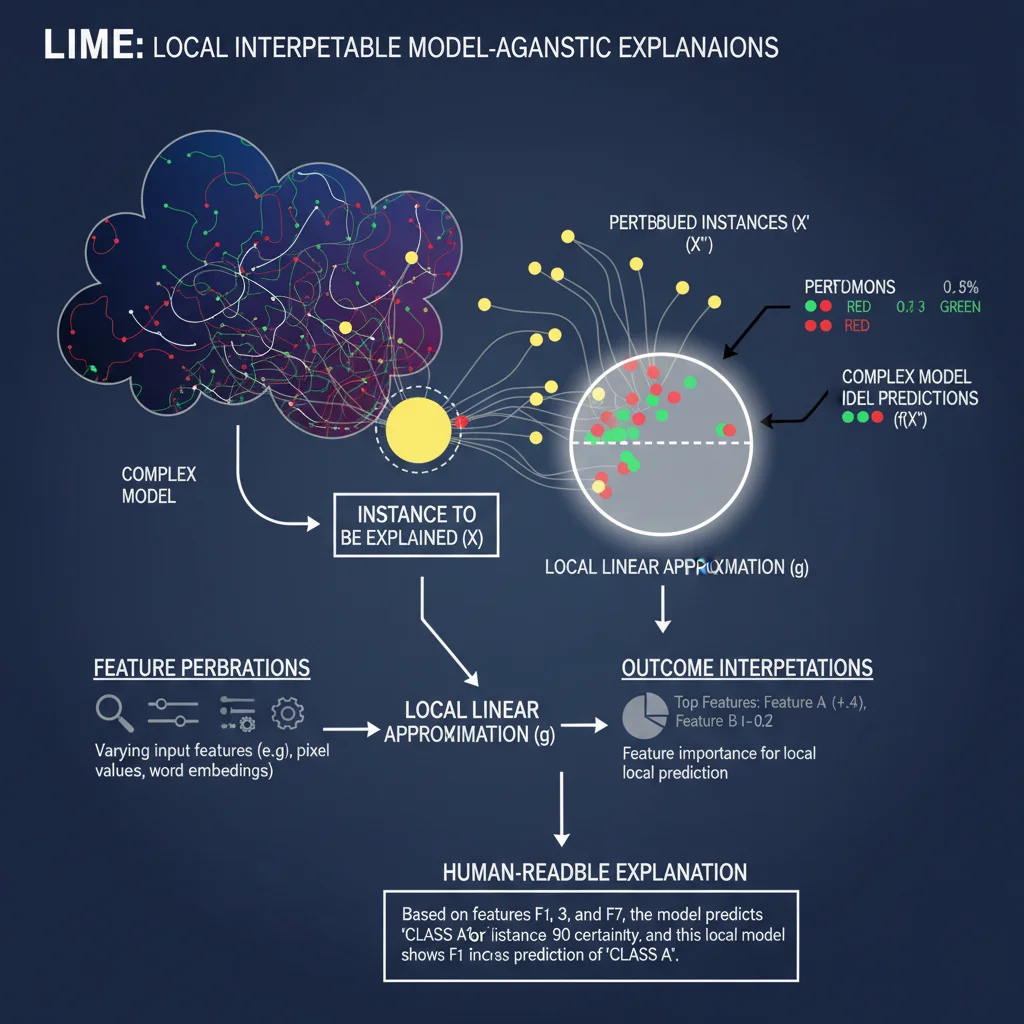
LIME stands as a cornerstone among Explainable AI Tools due to its model-agnostic nature and ability to provide local explanations. Developed by Marco Ribeiro, Sameer Singh, and Carlos Guestrin, LIME aims to explain the predictions of any classifier or regressor by approximating it locally with an interpretable model. The key idea is that while a complex model might be globally inscrutable, it can be approximated by a simpler, interpretable model (like linear regression or decision trees) around the specific instance being explained.
How it works: For a given prediction, LIME perturbs the input data multiple times to create slightly modified versions of the original input. It then queries the black-box model with these perturbed inputs and observes their predictions. By weighting these new samples based on their proximity to the original input, LIME trains a simple, interpretable model (e.g., a linear model) on this locally weighted dataset. The coefficients of this local model then serve as an explanation, indicating how much each feature contributes to the specific prediction for that instance.
Recent Updates and Significance: LIME’s enduring popularity stems from its flexibility. It doesn’t require access to the model’s internal architecture, only its prediction function. Recent updates often focus on improving the stability of explanations, optimizing the sampling process, and extending its applicability to various data types (text, images, tabular data). For US developers, LIME is invaluable for understanding individual controversial predictions, debugging specific model failures, and providing concrete reasons to end-users for a particular outcome. Its widespread adoption means robust community support and integration into many AI pipelines.
2. SHAP (SHapley Additive exPlanations)
SHAP, an acronym for SHapley Additive exPlanations, is another incredibly powerful and widely adopted member of the Explainable AI Tools family. Developed by Scott Lundberg and Su-In Lee, SHAP connects optimal credit allocation with local explanations using the classic Shapley values from cooperative game theory. Shapley values provide a fair distribution of the ‘payout’ (the prediction) among the ‘players’ (the features) in a game, ensuring that each feature’s contribution is accurately represented.
How it works: SHAP assigns each feature an importance value for a particular prediction. This value, the Shapley value, represents the average marginal contribution of that feature across all possible coalitions of features. In simpler terms, it quantifies how much a feature contributes to pushing the model’s output from the baseline (e.g., the average prediction) to the current prediction. Unlike LIME, which trains a local surrogate model, SHAP directly calculates feature contributions based on game theory principles, offering a more theoretically grounded approach.
Recent Updates and Significance: SHAP’s strength lies in its strong theoretical foundations and its ability to provide both local (instance-level) and global (model-level) explanations. It includes various ‘explainers’ optimized for different model types (e.g., TreeExplainer for tree-based models, DeepExplainer for deep learning models). Recent advancements in SHAP focus on computational efficiency for large datasets and complex models, as well as improved visualization techniques to make the explanations more accessible. For US developers, SHAP is critical for understanding feature importance, detecting feature interactions, and rigorously validating model behavior against domain expertise. It offers a standardized way to measure feature contributions, making it a go-to for ensuring fairness and identifying potential biases.
3. InterpretML
InterpretML is a powerful open-source package from Microsoft that brings together multiple Explainable AI Tools under a unified framework. Its primary goal is to empower developers and data scientists to train interpretable models and explain black-box models with ease. What sets InterpretML apart is its focus on both intrinsically interpretable models and post-hoc explanation techniques, offering a comprehensive suite for various XAI needs.
How it works: InterpretML offers two main approaches:
- Glassbox Models: These are models designed to be inherently interpretable, such as explainable boosting machines (EBMs) and generalized additive models (GAMs). EBMs, for instance, learn a separate function for each feature, allowing developers to visualize and understand the impact of individual features and their interactions directly, without needing post-hoc explanations.
- Blackbox Explanations: For complex black-box models, InterpretML integrates established techniques like SHAP and LIME, providing a consistent API for generating explanations. It also includes proprietary techniques like Mimic Explainer, which trains an interpretable model to mimic the black-box model’s behavior.
Recent Updates and Significance: Recent updates to InterpretML have focused on expanding the range of supported models, improving performance, and enhancing visualization capabilities. The inclusion of EBMs is particularly noteworthy, as it allows developers to build high-performance yet transparent models from the ground up, reducing the need for post-hoc explanations. For US developers, InterpretML is an excellent choice for projects where interpretability is a primary design constraint from the outset. It provides a robust, enterprise-grade solution for integrating XAI into the machine learning lifecycle, from model training to deployment and monitoring. Its comprehensive nature makes it a strong contender for a standardized XAI toolkit.
4. AI Explainability 360 (AIX360)
AI Explainability 360 (AIX360) is another comprehensive open-source toolkit developed by IBM Research. Similar to InterpretML, AIX360 provides a wide array of Explainable AI Tools, algorithms, and metrics for understanding, evaluating, and mitigating issues in AI models. Its strength lies in its breadth, covering various dimensions of explainability, including local and global explanations, contrastive explanations, and even counterfactual explanations.
How it works: AIX360 offers a diverse collection of explainers, each suited for different types of models and explanation objectives. Some notable explainers include:
- LIME and SHAP: As with InterpretML, AIX360 integrates these popular model-agnostic techniques.
- Prototypes: Explanations based on identifying representative data points (prototypes) that are similar to the instance being explained.
- Counterfactual Explanations: These answer questions like "What is the smallest change to the input that would change the prediction to a desired outcome?" This is particularly useful for actionable insights in domains like loan applications or medical diagnoses.
- Contrastive Explanations: Explaining why a prediction was made, rather than another specific prediction.
Recent Updates and Significance: IBM continually updates AIX360 with new explainers, improved performance, and better integration with popular machine learning frameworks. A significant focus has been on providing tools for fairness assessment and bias detection alongside explainability, reflecting the intertwined nature of these concerns. For US developers, AIX360 is particularly valuable for complex enterprise-level AI applications where a variety of explanation types are required. Its robust collection of algorithms makes it flexible enough to address diverse explainability challenges, from understanding individual predictions to assessing overall model fairness and identifying actionable changes. It’s a powerful resource for building responsible and robust AI solutions.

The Broader Impact: Ethical AI and Regulatory Compliance
The adoption of Explainable AI Tools extends far beyond technical convenience; it is fundamentally linked to the broader ethical considerations surrounding AI and the evolving regulatory landscape. As AI systems become more autonomous and influential, the ethical imperative to ensure fairness, accountability, and transparency intensifies. XAI provides the mechanisms to address these concerns head-on.
Ethical AI: Explainability is a cornerstone of ethical AI development. By understanding why a model makes certain decisions, developers can proactively identify and mitigate biases that might be inadvertently encoded in the training data or learned by the algorithm. For instance, if an XAI tool reveals that a hiring algorithm disproportionately weighs irrelevant demographic features, developers can intervene to correct this bias, ensuring more equitable outcomes. This proactive approach to fairness is essential for building AI that serves society justly and avoids perpetuating or amplifying existing societal inequalities. The ability to explain decisions also fosters accountability, allowing stakeholders to trace the responsibility for an AI’s actions.
Regulatory Compliance: Governments and regulatory bodies worldwide are increasingly recognizing the need for oversight in AI. In the US, while a comprehensive federal AI regulation is still in development, states like California are introducing legislation that touches upon AI transparency and accountability. Internationally, the EU’s AI Act, once fully implemented, will set a global benchmark for responsible AI, with strict requirements for high-risk AI systems to be explainable and auditable. These regulations often mandate the ability to provide clear, understandable explanations for automated decisions, especially those impacting individuals’ rights or opportunities. Mastering Explainable AI Tools will be crucial for US businesses and developers to ensure their AI systems comply with these burgeoning legal requirements, avoiding hefty fines and reputational damage.
Furthermore, XAI facilitates internal auditing and risk management. Companies can use explainability to demonstrate due diligence, prove non-discrimination, and maintain control over their AI deployments. This shift from simply deploying AI to deploying responsible AI is a fundamental change, and Explainable AI Tools are the primary enablers of this transition. For US developers, integrating XAI practices into their workflow is not just about staying ahead; it’s about building AI that is both powerful and principled.
Integrating XAI into the Development Lifecycle
For US developers, the true power of Explainable AI Tools is realized when they are seamlessly integrated into the entire machine learning development lifecycle, not just as an afterthought. This involves incorporating XAI considerations from the initial problem definition to model deployment and continuous monitoring.
1. Data Understanding and Preprocessing: XAI can begin even before model training. By using interpretability techniques on the raw data, developers can identify potential biases in the dataset itself. For example, analyzing feature distributions with respect to target variables can reveal implicit correlations that might lead to unfair outcomes. Understanding data relationships through XAI precursors can inform better feature engineering and data cleaning strategies.
2. Model Selection and Training: During model selection, developers can evaluate not only performance metrics but also the inherent interpretability of different model architectures. In some cases, a slightly less accurate but more interpretable model might be preferred if explainability is a critical requirement. During training, XAI tools can be used to monitor how different features influence the model’s learning process, helping to diagnose overfitting or underfitting related to specific data patterns.
3. Model Evaluation and Debugging: This is where Explainable AI Tools truly shine. Beyond traditional metrics like accuracy and precision, developers can use LIME, SHAP, and others to understand *why* the model made correct or incorrect predictions. This is invaluable for debugging. If a model consistently misclassifies a certain subgroup, XAI can reveal which features are causing this behavior, guiding targeted model improvements or data augmentation strategies.
4. Deployment and Monitoring: Once deployed, AI models need continuous monitoring not just for performance drift but also for explanation drift. As data distributions change over time, the reasons behind a model’s predictions might also shift. XAI tools can be used in production to monitor explanations, detect anomalies, and ensure that the model continues to operate fairly and as intended. Providing users with explanations for individual predictions at the point of interaction (e.g., "Your loan was approved because of your high credit score and stable employment history") builds trust and empowers users.
5. Auditing and Compliance: For regulatory compliance, XAI techniques provide the necessary documentation and evidence of an AI system’s decision-making process. Auditing trails can be generated from explanations, demonstrating that the model adheres to fairness principles and transparency requirements. This systematic integration ensures that XAI is not merely a feature but an intrinsic part of building responsible and reliable AI systems.
Challenges and Future Directions for Explainable AI Tools
While Explainable AI Tools have made significant strides, the field is not without its challenges, and future developments are crucial for its continued evolution. For US developers, being aware of these challenges and emerging trends is key to staying at the forefront of AI innovation.
Challenges:
- Fidelity vs. Simplicity: A core trade-off in XAI is between the fidelity of an explanation (how accurately it reflects the black-box model’s behavior) and its simplicity (how easy it is for a human to understand). Achieving both simultaneously remains a significant challenge, especially for highly complex models.
- Computational Cost: Many XAI techniques, particularly those involving perturbations or Shapley value calculations, can be computationally intensive, making them difficult to apply to very large models or in real-time scenarios.
- Stability and Robustness: Explanations generated by some tools can be sensitive to small changes in input or model parameters, leading to unstable or inconsistent explanations. Ensuring the robustness of explanations is an ongoing research area.
- Human-Centric Explanations: The ultimate goal of XAI is to provide explanations that are meaningful and actionable to humans. However, what constitutes a "good" explanation can vary greatly depending on the user, their background, and the context. Tailoring explanations to diverse audiences is complex.
- Ethical Misuse: Just as AI can be misused, explanations themselves can be manipulated or used to obscure underlying biases rather than reveal them. Ensuring the ethical use of XAI is paramount.
Future Directions:
- Causal Explanations: Moving beyond correlations to identify causal relationships in explanations is a major research frontier. Understanding not just what features are important, but *why* they are important and how changing them would causally alter an outcome, offers deeper insights.
- Interactive XAI: Developing interactive XAI systems that allow users to query explanations, explore counterfactuals, and dive deeper into model logic will enhance human understanding and trust.
- Standardization and Benchmarking: As the field matures, there’s a growing need for standardized metrics and benchmarks to evaluate the quality and effectiveness of different Explainable AI Tools and techniques.
- Integration with Neuro-Symbolic AI: Combining the strengths of deep learning with symbolic reasoning could lead to more inherently interpretable and robust AI systems.
- Domain-Specific XAI: Developing XAI techniques tailored to specific domains (e.g., medical imaging, legal text analysis) will improve their relevance and utility.
For US developers, staying abreast of these challenges and participating in the advancement of XAI will be crucial. The evolution of Explainable AI Tools will not only shape the future of AI development but also define the ethical and societal impact of these powerful technologies.
Conclusion: The Future is Transparent with Explainable AI Tools
The journey of AI is moving irrevocably towards a future where transparency, accountability, and trust are non-negotiable. For US developers aiming to build cutting-edge, responsible, and impactful AI systems by 2026, proficiency in Explainable AI Tools is no longer optional. It is a fundamental skill that underpins ethical considerations, regulatory compliance, and the very robustness of AI solutions.
We have explored the critical imperative behind XAI, distinguishing between interpretability and explainability, and highlighted four indispensable Explainable AI Tools: LIME, SHAP, InterpretML, and AI Explainability 360. Each of these offers unique strengths, from local instance explanations to comprehensive model understanding and intrinsically interpretable architectures. Integrating these tools throughout the AI development lifecycle – from data preprocessing to deployment and monitoring – ensures that XAI is not an afterthought but an integral part of the design process.
The challenges that remain in XAI, such as balancing fidelity with simplicity and managing computational costs, are active areas of research that promise exciting future developments. As these tools evolve, they will enable developers to craft AI systems that are not only powerful in their predictive capabilities but also clear in their reasoning, fair in their decisions, and ultimately, trustworthy in their impact. Embracing Explainable AI Tools is not just about meeting current demands; it’s about shaping a future where AI automation empowers humanity responsibly and intelligently.