Gig Economy 2026: Policy Debates & Financial Impact on Freelance Work

The gig economy, a dynamic force reshaping global labor markets, stands on the precipice of significant transformation. As we look towards 2026, the foundational principles that have governed freelance work are under intense scrutiny, sparking heated policy debates with profound financial implications for millions of workers and countless businesses. The flexibility and autonomy that define gig work are clashing with calls for greater worker protections and benefits, creating a complex regulatory landscape.
Understanding these evolving discussions is not merely an academic exercise; it is crucial for anyone involved in or impacted by the gig economy. From individual freelancers planning their financial futures to multinational corporations strategizing their workforce models, the outcomes of these policy debates will dictate operational frameworks, income stability, and overall market dynamics. This comprehensive article will delve into the five most critical policy debates shaping the gig economy’s next chapter, meticulously examining their potential financial reverberations.
The rapid growth of the gig economy has outpaced existing labor laws, many of which were designed for a bygone era of traditional employment. This regulatory lag has created a patchwork of rules and interpretations, leading to legal challenges, worker uncertainty, and business ambiguity. The coming years will see a concerted effort to bridge this gap, but the path forward is fraught with contention, as various stakeholders – governments, labor unions, platform companies, and gig workers themselves – advocate for often conflicting interests. Our exploration will provide a forward-looking perspective, equipping you with the insights needed to navigate this complex and ever-changing environment.
The Shifting Sands of Worker Classification: Employee vs. Independent Contractor
Perhaps the most contentious and financially impactful debate revolves around worker classification. The distinction between an ’employee’ and an ‘independent contractor’ is not just semantic; it carries immense legal, financial, and operational weight. For decades, the independent contractor model has been the bedrock of the gig economy, allowing platforms to scale rapidly without the overheads associated with traditional employment, such as payroll taxes, benefits, and minimum wage requirements. However, critics argue that many gig workers, despite their ‘independent’ label, exhibit characteristics more akin to employees, lacking true autonomy and control over their work.
The financial stakes for both sides are colossal. For platforms, reclassifying a significant portion of their workforce as employees could lead to a dramatic increase in operational costs. This includes expenses related to social security and Medicare taxes, unemployment insurance, workers’ compensation, minimum wage compliance, overtime pay, and the provision of benefits like health insurance, paid time off, and retirement plans. These costs could erode profit margins, force price increases for consumers, and potentially stifle innovation and expansion. Some companies might even reduce their reliance on gig workers or automate certain tasks to mitigate these new expenses.
Conversely, for gig workers, reclassification could unlock a host of financial protections and benefits previously unavailable. Access to unemployment insurance provides a crucial safety net during periods of low demand or illness. Workers’ compensation offers financial support for injuries sustained on the job. Minimum wage guarantees a baseline income, while overtime pay compensates for extended hours. Employer-sponsored health insurance and retirement plans could significantly alleviate the financial burden of healthcare costs and long-term financial planning. This shift could lead to greater financial stability and security for many individuals, reducing their vulnerability to economic fluctuations.
Globally, different jurisdictions are grappling with this issue. California’s AB5 law, which codified an ‘ABC test’ making it harder to classify workers as independent contractors, sent shockwaves through the industry, leading to Proposition 22, a ballot initiative that exempted ride-share and delivery companies from AB5 by creating a new classification with some benefits. The UK Supreme Court’s ruling on Uber drivers, classifying them as ‘workers’ (a hybrid category), also highlights the global push for re-evaluation. In 2026, we can anticipate more legislative action and judicial rulings worldwide, attempting to define clear lines or create new, hybrid categories that offer a middle ground. The financial impact will depend heavily on the specific criteria adopted and the scope of their application, but it’s clear that the era of unchallenged independent contractor status for many gig roles is drawing to a close.

Crafting Comprehensive Social Safety Nets for Gig Workers
Closely intertwined with worker classification is the debate surrounding social safety nets. Traditional employment models provide a framework for access to unemployment benefits, disability insurance, paid sick leave, and retirement savings plans, often through employer contributions. Gig workers, by virtue of their independent contractor status, largely fall outside these systems, leaving them exposed to significant financial risks.
The absence of a robust social safety net has profound financial implications for gig workers. A sudden illness or injury can lead to a complete loss of income without sick leave or disability benefits. Economic downturns or seasonal lulls can leave them without unemployment support. The burden of saving for retirement and healthcare falls entirely on the individual, often without the benefit of employer matching contributions or group insurance rates. This vulnerability can lead to financial precarity, forcing many to work longer hours, take on multiple gigs, or delay crucial financial planning.
For society as a whole, a large segment of the workforce lacking adequate safety nets can create broader economic instability. Increased reliance on public assistance programs, higher healthcare costs due to delayed care, and a growing population nearing retirement without sufficient savings are all potential long-term consequences. This realization is fueling policy discussions around how to extend social protections to gig workers without necessarily reclassifying them as full employees.
Several models are being explored. One approach involves creating portable benefits systems, where benefits are tied to the worker, not the platform, and contributions could come from multiple platforms a worker uses. This would allow gig workers to accrue benefits regardless of how many different companies they work for. Another idea is the establishment of universal basic income (UBI) or universal basic services (UBS) programs, which could provide a baseline level of financial security independent of employment status. Governments are also considering mandates for platforms to contribute to specialized funds for gig worker benefits, or tax incentives for individual gig workers to save for retirement and healthcare.
The financial implications of implementing such systems are complex. For platforms, mandatory contributions to benefit funds or taxes to support UBI/UBS could represent a new operational cost. However, a more financially secure gig workforce could also lead to higher worker retention, better service quality, and reduced societal costs in the long run. For workers, these new safety nets represent a significant financial gain, offering peace of mind and reducing the need for emergency savings, potentially freeing up capital for investment or consumption. By 2026, we expect to see pilot programs expand and legislative proposals gain traction, aiming to create more equitable and sustainable financial futures for gig workers.
Regulating Algorithmic Management and Data Practices
The gig economy is powered by algorithms. From assigning tasks and determining pay rates to evaluating performance and even deactivating accounts, algorithms play a central role in managing gig workers. While these systems offer efficiency and scalability for platforms, they also raise significant concerns about fairness, transparency, and worker autonomy, leading to a burgeoning policy debate around algorithmic management.
The financial implications of unregulated algorithmic management are substantial for gig workers. Opaque algorithms can lead to unpredictable income, as workers may not understand how their pay is calculated or why certain tasks are assigned over others. Arbitrary or biased deactivations, often without clear recourse, can instantly cut off a worker’s income stream. Performance metrics that are unclear or unfairly applied can lead to reduced opportunities and earnings. Furthermore, the data collected by platforms about workers’ performance, location, and behavior can be used in ways that disadvantage them, impacting their ability to negotiate better terms or even find work on other platforms.
For platforms, the current lack of stringent regulation allows for maximum operational flexibility and data utilization. However, growing public and regulatory pressure for greater transparency and fairness could lead to new compliance costs. This might include investments in auditing algorithms for bias, developing clearer communication channels for workers, and implementing robust appeals processes for algorithmic decisions. The financial cost of non-compliance, through fines or legal challenges, could also be significant.
Policy proposals in this area include mandating algorithmic transparency, requiring platforms to disclose how key decisions (like task allocation, pricing, and deactivation) are made. There are also calls for human oversight in critical algorithmic decisions, and for workers to have access to their performance data and the ability to challenge evaluations. Data protection regulations, like GDPR, are already impacting how platforms handle worker data, and we anticipate more specific legislation targeting the unique challenges of algorithmic management in the gig context.
By 2026, regulations around algorithmic management are likely to mature, aiming to strike a balance between platform efficiency and worker protection. Financially, this could mean more predictable and potentially fairer earnings for gig workers, reducing income volatility and increasing their bargaining power. For platforms, it will necessitate investments in ethical AI and transparent operational practices, but could also lead to increased trust from their workforce and reduced legal risks in the long run.
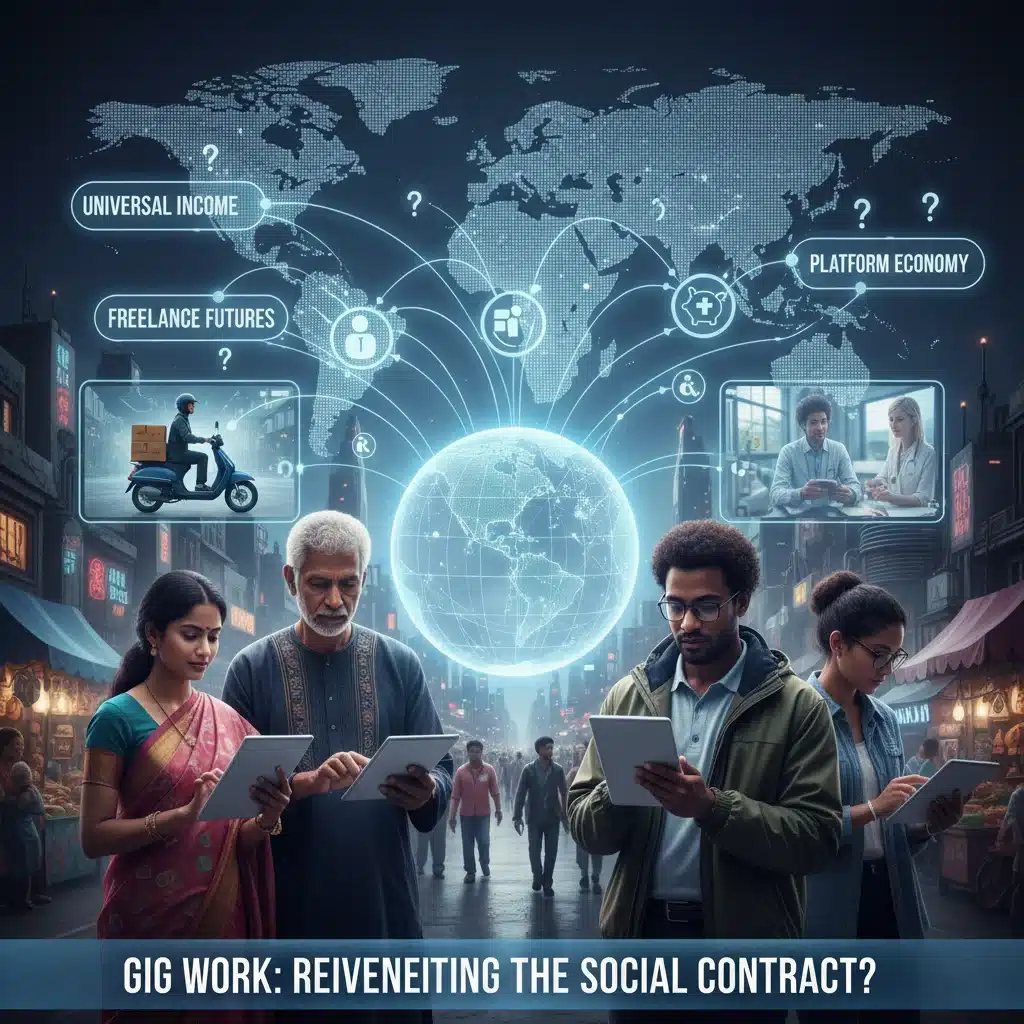
The Role of Collective Bargaining and Worker Representation
Traditional labor laws often link collective bargaining rights to employee status, leaving independent contractors largely outside the purview of unionization. However, the unique challenges faced by gig workers – including unpredictable income, lack of benefits, and algorithmic management – have spurred a global movement for greater worker representation and the right to collectively bargain.
The financial implications of collective bargaining for gig workers are potentially transformative. Unions or worker associations could negotiate for higher pay rates, better working conditions, and improved benefits. They could also advocate for more transparent and fair algorithmic practices, establish clearer grievance procedures, and provide legal support to members. This collective power could shift the balance away from individual, often precarious, negotiations with powerful platforms, leading to more stable and equitable financial outcomes for workers.
For gig economy platforms, the prospect of collective bargaining introduces a new layer of complexity and potential cost. Negotiated agreements could lead to increased labor expenses, potentially impacting profit margins. It could also reduce the operational flexibility that platforms currently enjoy, as changes to pay structures or working conditions would require consultation and agreement with worker representatives. Some platforms might view this as an impediment to innovation, while others might see it as an opportunity to build stronger, more stable relationships with their workforce.
Policy debates in this area center on how to enable collective bargaining for gig workers without forcing reclassification as employees, which could trigger other financial burdens. Some proposals include creating sectoral bargaining models, where agreements are reached across an entire industry rather than just a single company. Others suggest modifying antitrust laws, which sometimes prohibit independent contractors from collectively negotiating prices for their services, to allow for gig worker representation. Legislative efforts in various countries are exploring new legal frameworks that grant gig workers limited collective bargaining rights, even if they remain classified as independent contractors.
As we approach 2026, the push for collective bargaining rights for gig workers is gaining momentum. The financial impact will likely manifest as a gradual increase in earnings and benefits for workers, potentially funded by a reallocation of platform profits or a slight increase in consumer prices. For platforms, it will necessitate adapting to a more collaborative, and potentially confrontational, labor relations environment, requiring new strategies for engagement and negotiation with worker groups.
Ensuring Fair Competition and Platform Accountability
The rapid rise of dominant gig economy platforms has also ignited debates around fair competition, market concentration, and platform accountability. Many gig markets are characterized by a few large players, raising concerns about monopolistic practices, price fixing, and the ability of smaller, newer platforms to compete effectively. This debate extends beyond just economic principles to encompass broader issues of consumer protection and societal impact.
The financial implications of unchecked platform dominance for gig workers can be detrimental. A lack of competition can allow dominant platforms to dictate unfavorable terms, suppress pay rates, and impose stringent conditions without fear of losing workers to competitors. Workers might find themselves with limited choices, forced to accept whatever terms are offered, thereby eroding their earning potential and autonomy. For consumers, limited competition could lead to higher prices or reduced service quality in the long run.
For smaller platforms and startups, the financial barrier to entry can be immense, making it difficult to challenge established players. This stifles innovation and limits consumer choice. For large platforms, the current environment offers significant market power and the ability to extract substantial value. However, increased regulatory scrutiny could lead to financial penalties, divestment orders, or requirements to share data or infrastructure, impacting their business models.
Policy proposals addressing fair competition and platform accountability include strengthening antitrust enforcement to prevent anti-competitive mergers and practices. There are also calls for regulations that promote interoperability and data portability, allowing workers and consumers to more easily switch between platforms or for new platforms to integrate with existing infrastructure. Some suggest creating ‘data trusts’ or ‘data cooperatives’ where gig workers collectively own and control their data, leveraging it for better bargaining power or new service development. Additionally, debates around platform liability – holding platforms accountable for the actions of their workers or the quality of services – are gaining traction, potentially leading to new insurance requirements or legal obligations for platforms.
By 2026, we anticipate increased regulatory action aimed at fostering a more competitive and accountable gig economy landscape. Financially, this could lead to more equitable revenue sharing between platforms and workers, and potentially lower costs or more innovative services for consumers due to increased competition. For dominant platforms, it will mean adapting to a more regulated environment, potentially facing limitations on their market power and new compliance costs related to competition and accountability standards. The goal is to ensure that the benefits of the gig economy are more widely distributed, fostering a healthier ecosystem for all participants.
The Road Ahead: Navigating the Gig Economy’s Future
The gig economy is undeniably here to stay, but its future form is far from settled. The five policy debates we’ve explored – worker classification, social safety nets, algorithmic management, collective bargaining, and fair competition – are not isolated issues; they are deeply interconnected, each influencing the others. The outcomes of these discussions will collectively determine the financial viability, sustainability, and ethical framework of freelance work in 2026 and beyond.
For gig workers, understanding these debates is paramount to navigating their careers and advocating for their interests. Proactive engagement, whether through worker associations, advocacy groups, or simply staying informed, will be key to shaping a future where flexibility is balanced with security. Financially, workers must prepare for potential shifts in income stability, benefit access, and earning potential, adapting their personal financial planning accordingly.
For businesses, particularly platform companies, the coming years will demand strategic foresight and adaptability. Ignoring these policy trends is not an option; proactive engagement with policymakers, investment in ethical practices, and a willingness to innovate business models to accommodate new regulations will be critical for long-term success. The financial implications for platforms will range from increased operational costs to potential market restructuring, but also opportunities for enhanced public trust and a more stable, satisfied workforce.
Governments, too, face a formidable challenge: crafting regulations that protect workers without stifling innovation, promoting fair competition without over-regulating, and ensuring economic growth benefits all segments of society. The global nature of the gig economy further complicates matters, often requiring international cooperation or harmonized approaches to prevent regulatory arbitrage.
The journey towards a more mature and equitable gig economy will undoubtedly be complex, marked by continued negotiation, experimentation, and adaptation. The financial impact of these policy debates will be felt across the entire ecosystem, reshaping how work is done, how value is created, and how prosperity is shared. By staying informed and engaged, all stakeholders can contribute to building a gig economy that truly works for everyone, ensuring its next chapter is characterized by both innovation and justice.