Optimizing 5G Networks in 2026: A Guide for U.S. Businesses to Maximize Connectivity

Optimizing 5G Networks in 2026: A Guide for U.S. Businesses to Maximize Connectivity
In the rapidly evolving digital landscape, 5G technology stands as a cornerstone for innovation and competitive advantage. For U.S. businesses, understanding and effectively engaging in 5G network optimization is no longer an option but a strategic imperative. As we look towards 2026, the capabilities and demands on 5G networks will only intensify, making proactive optimization crucial for sustained growth and operational excellence. This comprehensive guide delves into the practical solutions and strategic considerations for U.S. businesses aiming to fully harness the power of 5G.
The Imperative of 5G Network Optimization for U.S. Businesses
The rollout of 5G has ushered in an era of unprecedented speed, low latency, and massive connectivity, fundamentally transforming how businesses operate. From enhancing customer experiences to enabling new business models, the potential of 5G is immense. However, simply having access to 5G is not enough. To truly leverage its benefits, U.S. businesses must engage in continuous 5G network optimization. This involves a multi-faceted approach that addresses infrastructure, security, application performance, and cost-efficiency.
Why 2026 is a Critical Juncture for 5G Strategy
By 2026, 5G adoption will be widespread across various industries, and the initial deployment challenges will have largely been overcome. This period marks a transition from early adoption to mature utilization, where differentiation will increasingly depend on how effectively businesses optimize their 5G infrastructure and services. Early adopters who have already begun their 5G network optimization journey will hold a significant advantage, having refined their strategies and integrated 5G into core business processes. Those who delay risk falling behind in a hyper-connected marketplace.
Key Benefits of Proactive 5G Network Optimization:
- Enhanced Operational Efficiency: Streamlined processes, faster data transfer, and improved communication.
- Superior Customer Experience: Reliable, high-speed connectivity for customer-facing applications and services.
- Innovation and New Capabilities: Enabling technologies like IoT, AI, AR/VR, and edge computing.
- Competitive Advantage: Differentiating services and products through advanced connectivity.
- Cost Savings: Optimizing network resources and reducing operational overheads in the long run.
- Robust Security: Implementing advanced security measures to protect sensitive data in a complex network environment.
Understanding the Pillars of 5G Network Optimization
Effective 5G network optimization requires a deep understanding of its core components and how they interact. It’s not just about speed; it’s about reliability, capacity, and the intelligent management of diverse network resources. Here, we break down the fundamental pillars that U.S. businesses need to focus on.
1. Network Infrastructure and Coverage Enhancement
The foundation of any robust 5G network is its physical and virtual infrastructure. For businesses, this means ensuring adequate indoor and outdoor coverage, especially in critical operational areas. While carriers are continually expanding their 5G footprints, businesses often need to supplement this with private 5G networks, small cells, and repeaters to guarantee seamless connectivity within their premises.
- Private 5G Networks: Offering dedicated, secure, and customizable connectivity for specific business needs, often critical for manufacturing, logistics, and healthcare. These networks provide greater control over data, security, and quality of service.
- Small Cells and Distributed Antenna Systems (DAS): Essential for improving indoor coverage and capacity in large buildings, campuses, or dense urban environments where macro cell signals may struggle to penetrate.
- Network Slicing: A key 5G feature allowing the creation of multiple virtual networks on a single physical infrastructure, each tailored to specific application requirements (e.g., high bandwidth for video, ultra-low latency for critical control systems). Businesses must work with their providers to define and utilize these slices effectively.
- Fiber Backhaul: Ensuring that the wired infrastructure supporting 5G base stations is robust and high-capacity is crucial. Bottlenecks in backhaul can negate the benefits of 5G’s wireless speeds.
2. Edge Computing Integration
Edge computing is a game-changer for 5G network optimization, bringing computational power closer to the data source. This significantly reduces latency and bandwidth usage, which is vital for real-time applications and processing large volumes of data generated by IoT devices.
- Reduced Latency: Critical for applications like autonomous vehicles, remote surgery, and industrial automation where milliseconds matter.
- Enhanced Security: Processing data locally reduces the need to transmit sensitive information to a central cloud, minimizing exposure to cyber threats.
- Improved Bandwidth Efficiency: Only relevant or aggregated data needs to be sent to the cloud, saving bandwidth and reducing costs.
- New Application Development: Edge computing fosters innovation by enabling a new generation of applications that require real-time processing and decision-making at the network edge.
3. Application Performance Management (APM)
Even with a stellar 5G network, applications can underperform if not properly optimized. Businesses must monitor and manage how their applications utilize 5G resources to ensure peak efficiency.
- Traffic Prioritization (QoS): Implementing Quality of Service (QoS) policies to prioritize critical business applications over less time-sensitive traffic.
- Application-Specific Optimization: Tailoring applications to take full advantage of 5G’s capabilities, such as designing for lower latency or higher bandwidth.
- Continuous Monitoring: Utilizing APM tools to track application performance, identify bottlenecks, and proactively address issues before they impact users.
Practical Strategies for U.S. Businesses in 2026
Translating theoretical knowledge into actionable strategies is key. Here are practical steps U.S. businesses can take to achieve effective 5G network optimization.
1. Conduct a Comprehensive Network Audit
Before any optimization efforts, businesses need to understand their current state. A thorough audit of existing network infrastructure, current 5G coverage (both public and private), and application performance baselines is essential. This audit should identify gaps, bottlenecks, and areas for improvement.
- Assess Current 5G Footprint: Map out existing 5G coverage areas within your facilities and across your operational zones.
- Identify Performance Bottlenecks: Pinpoint areas where latency is high, speeds are inconsistent, or capacity is insufficient.
- Evaluate Application Requirements: Understand the specific bandwidth, latency, and reliability needs of your critical business applications.
2. Invest in Hybrid 5G Solutions
For many U.S. businesses, a purely public 5G network may not suffice. A hybrid approach, combining public 5G with private 5G networks or dedicated spectrum, offers the best of both worlds: widespread connectivity and localized control.
- Private 5G for Core Operations: Deploy private 5G networks for mission-critical applications that require guaranteed performance and security, such as industrial automation, smart factories, or secure data transfer.
- Public 5G for Broader Connectivity: Leverage public 5G networks for mobile workforce connectivity, remote operations, and less sensitive data transfer.
- Collaborate with Carriers: Work closely with mobile network operators to integrate private and public 5G solutions seamlessly.
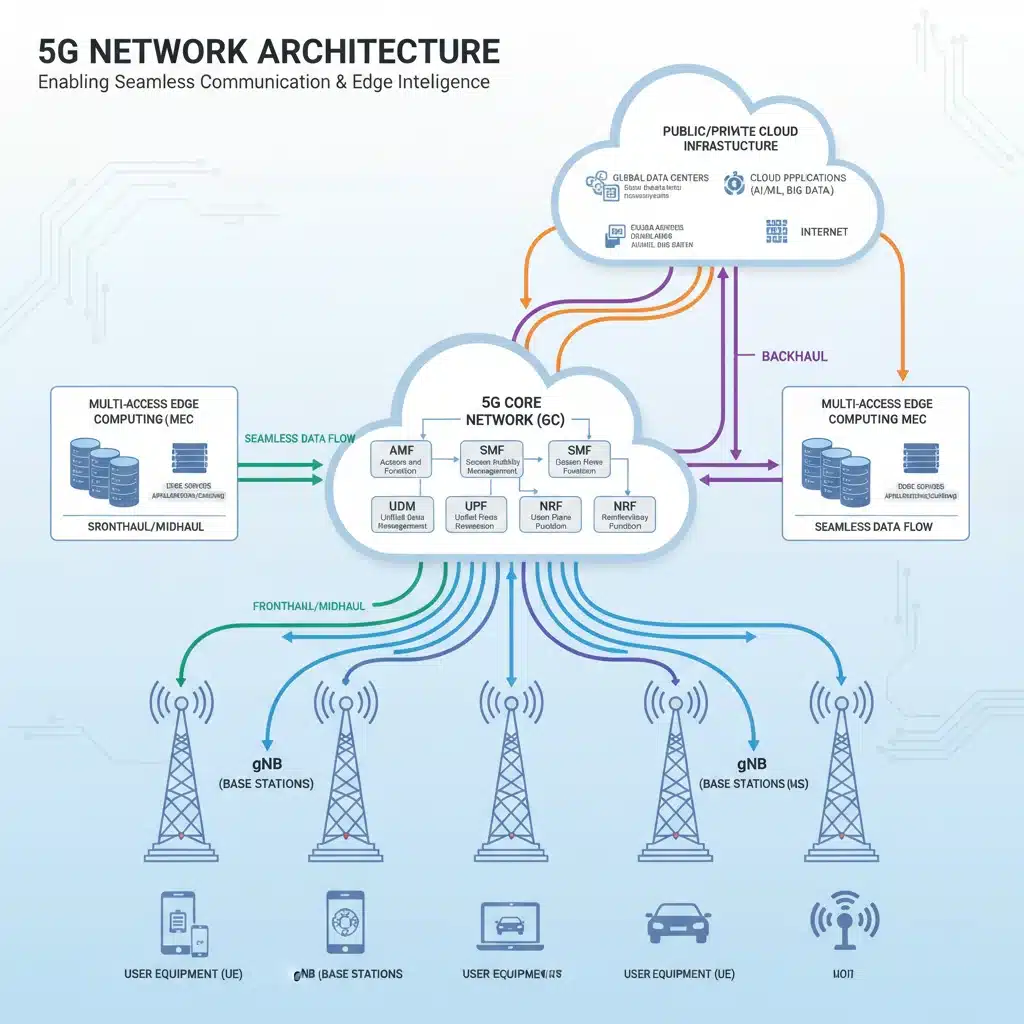
3. Embrace Edge Computing for Data Processing
Strategically deploying edge computing resources will be paramount for 5G network optimization. This involves placing mini-data centers or computing capabilities at the network edge, closer to where data is generated and consumed.
- Identify Edge-Enabled Applications: Determine which applications can benefit most from edge computing (e.g., real-time analytics, AI inference, IoT device management).
- Deploy Edge Infrastructure: Invest in edge servers, gateways, and software platforms that can process data locally.
- Develop Edge-Native Applications: Re-architect or develop applications specifically designed to leverage the low latency and high bandwidth of edge-enabled 5G.
4. Implement Robust Cybersecurity Measures
The expanded attack surface of 5G networks necessitates a proactive and comprehensive cybersecurity strategy. 5G network optimization must go hand-in-hand with enhanced security protocols.
- Zero Trust Architecture: Implement a zero-trust model where no user or device is inherently trusted, regardless of their location on the network.
- Advanced Threat Detection: Utilize AI-driven security tools to detect and respond to anomalies and threats in real-time across the 5G ecosystem.
- Endpoint Security: Secure all connected devices, from IoT sensors to employee smartphones, as they represent potential entry points for attackers.
- Network Segmentation: Isolate critical systems and data through network slicing and segmentation to limit the impact of a breach.
5. Leverage AI and Machine Learning for Network Management
Artificial intelligence and machine learning are invaluable tools for optimizing complex 5G networks. They can automate monitoring, predict issues, and fine-tune network parameters more efficiently than human operators alone.
- Predictive Maintenance: AI can analyze network data to predict potential failures or performance degradation before they occur, allowing for proactive intervention.
- Automated Resource Allocation: ML algorithms can dynamically allocate network resources (e.g., bandwidth, computing power) based on real-time demand, ensuring optimal performance for all applications.
- Anomaly Detection: AI can quickly identify unusual network behavior that might indicate a security threat or performance issue, reducing response times.
Challenges and Considerations in 5G Network Optimization
While the benefits are clear, U.S. businesses will face several challenges in their quest for optimal 5G performance. Addressing these proactively is crucial for successful 5G network optimization.
1. Cost of Deployment and Upgrade
Investing in new infrastructure, private networks, and edge computing can be substantial. Businesses need to carefully evaluate the ROI and prioritize investments based on their strategic objectives.
- Phased Rollouts: Consider a phased approach to deployment, starting with critical areas or applications and expanding over time.
- Partnerships: Explore partnerships with network providers, technology vendors, and even other businesses to share costs and expertise.
- Government Incentives: Research potential government grants or tax incentives for 5G infrastructure development.
2. Skill Gap and Talent Acquisition
The specialized nature of 5G and edge computing requires a workforce with specific skills. Many organizations may face a talent shortage in these areas.
- Upskilling Existing Staff: Invest in training programs for current IT and engineering teams to develop 5G expertise.
- Strategic Hiring: Recruit specialists in 5G architecture, network security, and edge computing.
- Managed Services: Consider outsourcing certain aspects of 5G network management to specialized third-party providers.
3. Interoperability and Ecosystem Complexity
A typical 5G environment involves a complex ecosystem of hardware, software, and services from various vendors. Ensuring seamless interoperability is vital.
- Open Standards: Prioritize solutions that adhere to open standards to avoid vendor lock-in and ensure compatibility.
- Thorough Testing: Implement rigorous testing protocols for all new components and integrations within the 5G network.
- Vendor Management: Establish strong relationships with key vendors and ensure clear communication and collaboration.
4. Regulatory and Policy Landscape
The regulatory environment for 5G, particularly concerning spectrum allocation, data privacy, and security standards, is constantly evolving. U.S. businesses must stay informed and compliant.
- Legal Counsel: Engage legal and regulatory experts to navigate the complex landscape of 5G policies.
- Industry Associations: Participate in industry groups to stay abreast of changes and contribute to policy discussions.
- Data Governance: Establish robust data governance policies to comply with privacy regulations like CCPA and potential federal privacy laws.
Future-Proofing Your Business with Advanced 5G Optimization
Looking beyond 2026, the journey of 5G network optimization is continuous. Businesses that adopt a forward-thinking approach will be best positioned to capitalize on emerging technologies and market shifts.
1. Embracing 5G-Advanced and 6G Preparations
While 5G is the focus, the next iterations are already on the horizon. 5G-Advanced (3GPP Release 18 and beyond) will bring further enhancements, and early research into 6G is underway. Businesses should monitor these developments to anticipate future requirements.
- Scalable Infrastructure: Invest in infrastructure that can be easily upgraded or adapted to future standards.
- Research and Development: Allocate resources for R&D into how future network technologies can further benefit your business.
2. Sustainability in 5G Deployments
As 5G networks become more pervasive, their energy consumption will increase. Sustainable 5G network optimization involves minimizing the environmental footprint of these advanced networks.
- Energy-Efficient Hardware: Choose network equipment designed for low power consumption.
- Renewable Energy Sources: Power network infrastructure with renewable energy where feasible.
- Optimized Network Operations: Use AI and automation to manage network resources more efficiently, reducing energy waste.

3. The Role of Digital Twins in Network Management
Digital twins, virtual replicas of physical systems, can play a pivotal role in advanced 5G network optimization. By simulating network behavior, businesses can test changes, predict performance, and identify issues without impacting live operations.
- Simulation and Testing: Create digital twins of your 5G network to simulate various scenarios, such as traffic spikes or new application deployments.
- Predictive Analytics: Use digital twins to predict how network changes will affect performance and user experience.
- Troubleshooting: Isolate and diagnose network issues in the virtual environment before implementing solutions in the real world.
4. Data-Driven Decision Making
The vast amounts of data generated by 5G networks and connected devices offer unprecedented opportunities for insights. Businesses must develop capabilities to collect, analyze, and act upon this data for continuous improvement.
- Unified Data Platforms: Implement platforms that can aggregate data from various network components and applications.
- Advanced Analytics: Utilize data science teams and tools to extract meaningful insights from network data.
- Feedback Loops: Establish processes to feed insights back into network design, configuration, and operational strategies.
Conclusion: Paving the Way for a Connected Future
For U.S. businesses, the journey of 5G network optimization is a continuous and dynamic process. As we move towards 2026 and beyond, the ability to strategically plan, implement, and refine 5G strategies will be a defining factor for success. By focusing on robust infrastructure, integrating edge computing, prioritizing security, and leveraging advanced technologies like AI and digital twins, businesses can unlock the full potential of 5G. This proactive approach will not only maximize connectivity and enhance operational efficiency but also foster innovation, secure digital assets, and establish a formidable competitive edge in the increasingly interconnected global economy. Embrace the challenge, invest wisely, and prepare to thrive in the era of advanced 5G.