2026 US Patent Landscape: Emerging Technologies & Growth Potential

The year 2026 is rapidly approaching, and with it, a new era of technological innovation poised to reshape industries and economies worldwide. For businesses, investors, and innovators, understanding the US Patent Landscape 2026 is not merely an academic exercise; it is a strategic imperative. The intellectual property (IP) ecosystem, particularly in the United States, serves as a critical barometer for future economic growth and technological advancement. By analyzing patent trends, we can gain invaluable insider knowledge on the emerging technologies with the highest growth potential, offering a glimpse into the innovations that will define our near future.
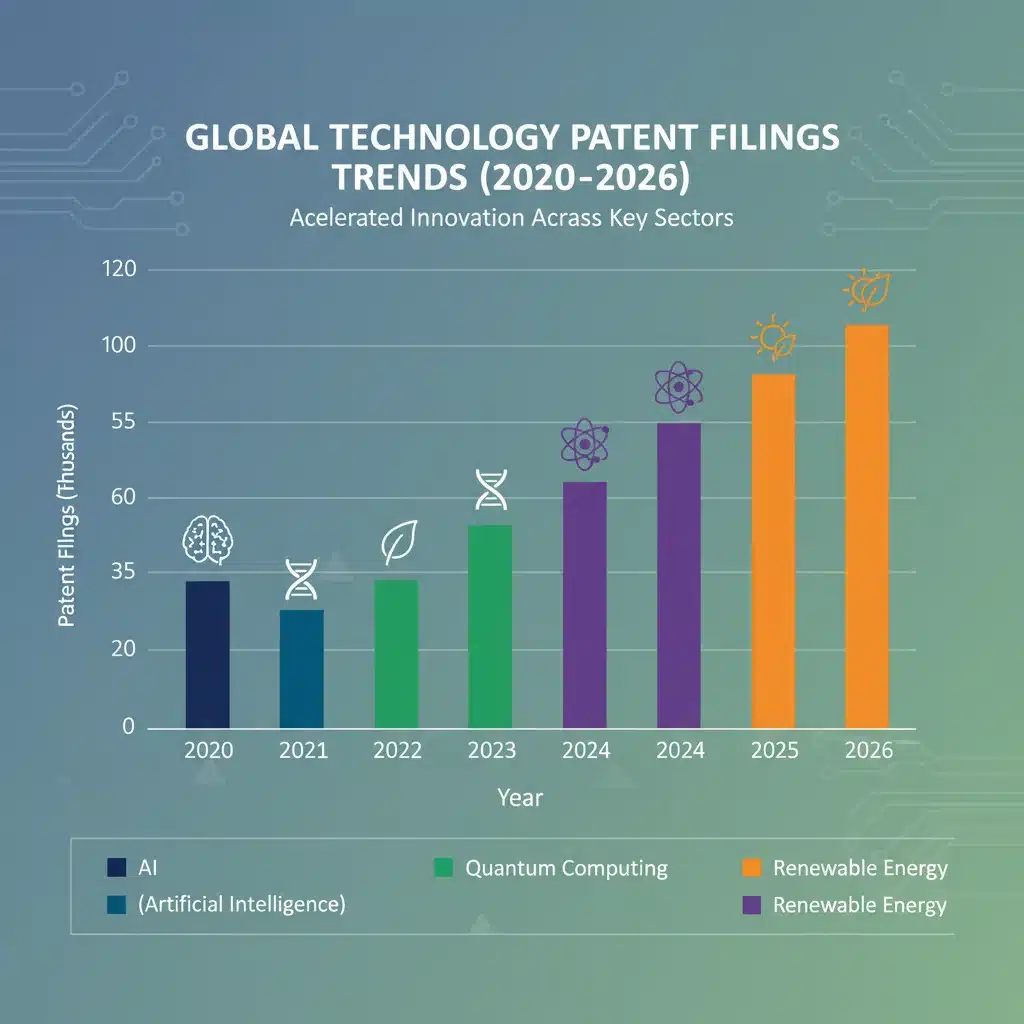
The pace of innovation has never been faster. Breakthroughs in artificial intelligence, biotechnology, quantum computing, and sustainable technologies are not just theoretical concepts but are rapidly moving from research labs to commercial applications. Each of these advancements is accompanied by a surge in patent filings, as companies and individuals seek to protect their inventions and secure a competitive edge. This article will delve deep into the US Patent Landscape 2026, providing a comprehensive overview of the key trends, challenges, and opportunities that lie ahead.
Navigating this complex landscape requires a keen understanding of both the technological advancements themselves and the legal frameworks designed to protect them. The United States Patent and Trademark Office (USPTO) is at the forefront of this, processing millions of applications and shaping the future of innovation. Our analysis will provide insider knowledge, drawing on current data and expert predictions to highlight the sectors most likely to experience significant patent activity and, consequently, substantial market growth. Prepare to uncover the strategic insights that will empower you to make informed decisions in this dynamic environment.
The Shifting Sands of Innovation: A Macro View of the US Patent Landscape 2026
The US Patent Landscape 2026 is characterized by several overarching trends. Firstly, there’s a noticeable acceleration in the number of patent applications, driven by increased R&D investment and a global race for technological supremacy. Secondly, interdisciplinary innovation is becoming the norm, with breakthroughs often occurring at the intersection of previously disparate fields. For instance, advancements in AI are now critical to drug discovery in biotechnology, and material science plays a crucial role in developing efficient renewable energy solutions.
Thirdly, the geopolitical context significantly influences patent strategies. National security concerns, trade disputes, and government incentives are all playing a role in shaping where and how patents are filed. The US, as a global leader in innovation, remains a prime destination for patent protection, but competition from other nations, particularly in Asia, is intensifying. This competitive environment necessitates a more strategic approach to patenting, focusing not just on novelty but also on market relevance and enforceability.
Finally, the legal and regulatory environment is continually evolving. Patent eligibility criteria, particularly for software and business methods, are subject to ongoing debate and judicial interpretation. Understanding these nuances is crucial for successful patent prosecution and defense. Companies must stay abreast of these changes to ensure their IP strategies remain robust and effective in the face of legal challenges.
Key Drivers of Patent Growth in the US
Several factors are fueling the expansion of the US Patent Landscape 2026. Government funding for basic research, often channeled through agencies like the National Science Foundation (NSF) and the National Institutes of Health (NIH), provides the foundational knowledge upon which many patented inventions are built. Additionally, corporate R&D spending, particularly by large tech companies, continues to be a major catalyst. These corporations often have dedicated IP departments that actively pursue patent protection for their innovations.
The rise of venture capital and private equity investment in early-stage technology companies also plays a significant role. Startups, eager to secure funding and establish market dominance, often prioritize patenting their core technologies. This creates a vibrant ecosystem where innovation is not just encouraged but actively protected. Furthermore, the increasing global interconnectedness means that innovations developed elsewhere often find their way into the US patent system, either through direct filings or through strategic partnerships and acquisitions.
Emerging Technologies with the Highest Growth Potential in the US Patent Landscape 2026
Identifying the specific technologies poised for explosive growth is central to understanding the US Patent Landscape 2026. While many fields are advancing, a few stand out due to their transformative potential and the sheer volume of patent activity they generate. These are the areas where innovators, investors, and policymakers should focus their attention.
Artificial Intelligence (AI) and Machine Learning (ML)
AI and ML continue to be at the forefront of technological innovation. From advanced algorithms for data analysis to sophisticated neural networks for image recognition and natural language processing, the applications of AI are virtually limitless. In the US Patent Landscape 2026, we expect to see a continued surge in patents related to:
- Generative AI: Technologies capable of creating new content, such as text, images, and even code, will see significant patenting activity. This includes advancements in large language models (LLMs) and diffusion models.
- Edge AI: AI processing moving closer to the data source, enabling faster decision-making and reduced reliance on cloud infrastructure. Patents in this area will focus on efficient algorithms and specialized hardware.
- AI Ethics and Explainability: As AI becomes more pervasive, patents related to ensuring fairness, transparency, and accountability in AI systems will become increasingly important.
- AI in Specific Applications: Healthcare (drug discovery, diagnostics), autonomous vehicles, finance (fraud detection), and manufacturing (predictive maintenance) will continue to be fertile grounds for AI-related patents.
Biotechnology and Personalized Medicine
The biotechnology sector is experiencing a renaissance, driven by advancements in genomics, gene editing, and synthetic biology. The US Patent Landscape 2026 will reflect this dynamism, with significant patenting in:
- CRISPR and Gene Editing Technologies: Improvements in precision, delivery methods, and therapeutic applications of gene editing will continue to generate numerous patents.
- mRNA Technologies: Beyond vaccines, mRNA’s potential for therapeutic applications in cancer treatment and other diseases will lead to a new wave of patent filings.
- Personalized Medicine and Diagnostics: Patents related to companion diagnostics, pharmacogenomics, and individualized treatment plans based on genetic profiles will be crucial.
- Bioinformatics and Computational Biology: The intersection of biology and data science, particularly in drug discovery and development, will be a hotbed of patent activity.
Quantum Computing and Cryptography
While still in its nascent stages, quantum computing holds immense promise for solving problems currently intractable for classical computers. The US Patent Landscape 2026 will begin to show more concrete developments in this highly specialized field:
- Quantum Hardware Architectures: Patents covering superconducting qubits, trapped ions, photonic quantum computers, and other physical implementations.
- Quantum Algorithms: New algorithms designed to leverage quantum mechanics for tasks like optimization, simulation, and cryptography.
- Post-Quantum Cryptography: As quantum computers pose a threat to current encryption standards, patents for new cryptographic methods resistant to quantum attacks will be critical.
- Quantum Sensing and Metrology: Applications of quantum phenomena for highly sensitive measurements in fields like medicine and defense.
Sustainable Technologies and Green Innovation
With increasing global attention on climate change and environmental sustainability, green technologies are experiencing unprecedented growth. The US Patent Landscape 2026 will heavily feature innovations in:
- Renewable Energy Storage: Advanced battery technologies (solid-state, flow batteries), hydrogen storage, and other energy storage solutions.
- Carbon Capture, Utilization, and Storage (CCUS): Technologies for removing carbon dioxide from the atmosphere and industrial emissions, and converting it into useful products.
- Sustainable Agriculture: Precision agriculture, vertical farming, drought-resistant crops, and alternative proteins.
- Circular Economy Solutions: Innovations in recycling, waste-to-energy conversion, and biodegradable materials.
- Electric Vehicles and Infrastructure: Advancements in EV battery efficiency, charging infrastructure, and autonomous electric vehicles.
Challenges and Opportunities in the US Patent Landscape 2026
While the opportunities presented by these emerging technologies are vast, the US Patent Landscape 2026 also presents significant challenges. Navigating these complexities effectively will be key to success for any entity involved in innovation.
Challenges:
- Patent Trolls and Litigation: The proliferation of non-practicing entities (NPEs) continues to be a concern, leading to costly and time-consuming litigation. Companies must develop robust defense strategies.
- Rapid Technological Obsolescence: The fast pace of innovation means that some patented technologies can become obsolete quickly, reducing the return on investment for patenting efforts. Strategic patenting, focusing on foundational technologies, becomes even more critical.
- Global Harmonization Issues: Despite efforts, significant differences remain between patent laws in various jurisdictions, complicating international patent strategies.
- Talent Shortage: A lack of skilled patent attorneys and examiners with expertise in highly specialized emerging technologies can slow down the patenting process and affect patent quality.
Opportunities:
- Strategic Partnerships and Licensing: Collaboration between startups, established companies, and academic institutions can accelerate innovation and facilitate market entry. Licensing patented technologies can be a significant revenue stream.
- Enhanced IP Due Diligence: For investors and M&A activities, thorough IP due diligence is more critical than ever. Identifying strong patent portfolios can unlock significant value.
- Government Incentives and Funding: Governments often provide grants, tax breaks, and other incentives for R&D in strategic technological areas, presenting opportunities for innovators.
- Data-Driven Patent Strategy: Utilizing AI and big data analytics to identify white spaces, predict patent trends, and optimize filing strategies can provide a significant competitive advantage in the US Patent Landscape 2026.
Insider Knowledge: Navigating the Patent Process in 2026
For those looking to secure patents in the evolving US Patent Landscape 2026, certain insider tips can prove invaluable. The patent application process can be lengthy and complex, but a well-executed strategy can significantly improve success rates and the strength of the resulting patent.
Early Disclosure and Provisional Applications
One of the most critical pieces of advice is to consider filing a provisional patent application early in the development cycle. A provisional application establishes an early filing date without the formal requirements of a non-provisional application. This allows inventors to secure their priority date while continuing to refine their invention and gather market feedback. It’s a cost-effective way to gain up to 12 months before deciding whether to proceed with a full non-provisional application, which is essential in the fast-moving US Patent Landscape 2026.
Thorough Patent Searches
Before investing significant resources into a patent application, conduct comprehensive patentability searches. This helps to identify existing prior art that could invalidate your claims and allows you to refine your invention to highlight its novel aspects. A professional patent search can save considerable time and money in the long run by preventing the pursuit of unpatentable inventions.
Crafting Strong Claims
The claims are the most important part of a patent application, defining the scope of protection. Working with an experienced patent attorney to draft broad yet defensible claims is paramount. In the context of rapidly evolving technologies, claims must be carefully worded to cover current embodiments of the invention as well as foreseeable future variations, ensuring long-term value within the US Patent Landscape 2026.
Responding to Office Actions Strategically
It’s common for the USPTO to issue Office Actions, raising objections or rejections based on prior art or statutory requirements. How you respond to these actions can significantly impact the outcome. A strategic response involves not just addressing the examiner’s points but also understanding their perspective and, where appropriate, negotiating the scope of the claims. This iterative process is a critical part of securing a strong patent.
International Considerations
Given the global nature of innovation, consider international patent protection from the outset. The Patent Cooperation Treaty (PCT) offers a streamlined way to seek patent protection in numerous countries simultaneously, delaying the costs associated with national filings. A well-thought-out international strategy is crucial for technologies with global market potential, especially in the competitive US Patent Landscape 2026.

The Intersection of Policy and Innovation: Shaping the Future
Government policies and legislative actions play a pivotal role in shaping the US Patent Landscape 2026. Decisions made today regarding funding for scientific research, intellectual property enforcement, and international trade agreements will have profound effects on the trajectory of innovation.
Government Funding and Research Initiatives
Continued investment in foundational research through agencies like DARPA, NIH, and DOE is essential. These investments often lead to breakthrough discoveries that form the basis of future patented technologies. Policies that encourage public-private partnerships can further accelerate the transfer of technology from academic labs to commercial markets.
IP Enforcement and Protection
A robust system for intellectual property enforcement is critical for incentivizing innovation. Policies that strengthen patent rights and provide effective remedies against infringement give innovators the confidence to invest in R&D. Conversely, policies that weaken patent protection can stifle innovation by reducing the perceived value of obtaining a patent.
International Trade and Patent Diplomacy
The US engages in ongoing discussions and negotiations with other countries regarding intellectual property rights. These efforts aim to harmonize patent laws, combat counterfeiting, and ensure fair treatment for US innovators abroad. The outcomes of these diplomatic efforts will undoubtedly influence the global reach and value of US patents in 2026 and beyond.
Regulatory Frameworks for Emerging Technologies
As technologies like AI and biotechnology advance, new regulatory challenges emerge. Policies related to data privacy, ethical AI development, and the safe application of gene-edited organisms will directly impact which innovations are pursued and how they are patented. A balanced regulatory approach that fosters innovation while safeguarding public interest is crucial.
Conclusion: Positioning for Success in the US Patent Landscape 2026
The US Patent Landscape 2026 is a dynamic and complex arena, brimming with both immense opportunities and significant challenges. Emerging technologies such as Artificial Intelligence, Biotechnology, Quantum Computing, and Sustainable Technologies are not just buzzwords; they represent the frontier of innovation and the engines of future economic growth. For those with the foresight and strategic acumen to navigate this landscape, the rewards can be substantial.
Understanding the key trends, anticipating regulatory shifts, and adopting a proactive approach to intellectual property protection are paramount. Whether you are an individual inventor, a startup, a large corporation, or an investor, gaining insider knowledge into these emerging technologies and the patenting process is no longer optional—it is a necessity. By focusing on areas of high growth potential, conducting thorough due diligence, and crafting robust patent strategies, you can position yourself for success in the competitive and rapidly evolving world of innovation.
The future is being patented today. By staying informed and strategically engaged with the US Patent Landscape 2026, you can not only witness the next wave of transformative technologies but also be an integral part of shaping it. The insights provided in this article serve as a guide to help you identify where the most significant opportunities lie and how to effectively capitalize on them, ensuring your innovations are protected and poised for impact.