Choosing the Right ML Platform: 2026 Feature & Scalability Review for US Data Science Teams

Choosing the Right ML Platform: A 2026 Feature and Scalability Review for US Data Science Teams
The landscape of machine learning (ML) platforms is evolving at a breakneck pace. For US data science teams, navigating this complex terrain to select the optimal solution is more critical than ever in 2026. The right ML Platform Comparison 2026 isn’t just about current capabilities; it’s about future-proofing your operations, ensuring seamless integration, and maximizing the return on investment in AI initiatives. This comprehensive guide delves deep into the essential features, scalability considerations, and strategic insights necessary for making an informed decision in the current technological climate.
The Evolving Needs of US Data Science Teams in 2026
Data science teams across the United States are facing unprecedented demands. The sheer volume of data, the complexity of models, and the increasing need for real-time insights mean that traditional approaches are no longer sufficient. Modern ML platforms must address several key pain points:
- Accelerated Model Development: From data ingestion and feature engineering to model training and validation, teams need tools that streamline every stage of the ML lifecycle.
- Seamless MLOps Integration: The journey from development to production is often fraught with challenges. Robust MLOps capabilities, including version control, automated deployment, monitoring, and retraining, are non-negotiable.
- Scalability and Performance: As data sets grow and models become more complex, the ability to scale computational resources on demand without compromising performance is paramount.
- Collaboration and Governance: Data science is rarely a solo endeavor. Platforms must facilitate collaboration among team members, ensure data governance, and maintain model explainability and fairness.
- Cost-Effectiveness: While powerful, ML platforms must also offer a clear path to cost optimization, allowing teams to manage resources efficiently.
Understanding these evolving needs forms the bedrock of any effective ML Platform Comparison 2026. It’s not just about what a platform can do, but how well it aligns with your team’s specific workflows and strategic objectives.
Key Features to Consider in Your ML Platform Comparison 2026
When evaluating ML platforms, a detailed feature comparison is essential. Here are the core functionalities that US data science teams should prioritize:
1. Data Management and Preparation
The quality of your models is directly tied to the quality of your data. A superior ML platform offers:
- Data Ingestion & Connectors: Support for a wide array of data sources (databases, data lakes, streaming data, APIs) with efficient ingestion mechanisms.
- Feature Store: A centralized repository for managing, discovering, and serving curated features. This is crucial for consistency, reusability, and reducing feature engineering time.
- Data Transformation & Cleaning Tools: Intuitive tools for data manipulation, cleaning, imputation, and normalization, often with visual interfaces.
- Data Versioning & Lineage: Tracking changes to data over time and understanding its origin is vital for reproducibility and compliance.
2. Model Development and Training
This is where the core data science work happens. Platforms must provide:
- Integrated Development Environment (IDE): Support for popular languages (Python, R, Julia) and frameworks (TensorFlow, PyTorch, Scikit-learn), often with cloud-based notebooks.
- Automated Machine Learning (AutoML): Capabilities for automating repetitive tasks like hyperparameter tuning, model selection, and even feature engineering, accelerating development for both expert and citizen data scientists.
- Distributed Training: The ability to train models across multiple GPUs or CPUs, essential for large datasets and complex deep learning models.
- Experiment Tracking & Management: Tools to log, track, and compare different model experiments, configurations, metrics, and artifacts.
- Model Versioning: Keeping track of different model iterations and their associated metadata.
3. MLOps: Deployment, Monitoring, and Governance
The operationalization of ML models is often the most challenging aspect. A robust ML Platform Comparison 2026 must heavily weigh MLOps capabilities:
- Model Deployment: Seamless deployment of models to various environments (batch, real-time, edge) with API generation and containerization support.
- Model Monitoring: Continuous tracking of model performance, data drift, concept drift, and potential biases in production. Alerts and dashboards are critical here.
- Model Retraining Pipelines: Automated pipelines for periodic model retraining based on performance degradation or new data.
- Explainable AI (XAI): Tools to understand why a model made a particular prediction, crucial for trust, debugging, and regulatory compliance.
- Bias Detection & Mitigation: Features to identify and address biases in training data and model predictions.
- Security & Access Control: Robust security measures, role-based access control (RBAC), and compliance certifications.

4. Collaboration and Ecosystem Integration
Data science teams don’t operate in a vacuum. Platforms should offer:
- Shared Workspaces: Centralized environments for teams to collaborate on projects, share code, and review models.
- Version Control Integration: Seamless integration with popular VCS like Git.
- API & SDK Support: Comprehensive APIs and SDKs for programmatic interaction and integration with existing enterprise systems.
- Third-Party Tool Integration: Compatibility with a wide range of data science and MLOps tools, visualization libraries, and cloud services.
Scalability: A Critical Differentiator in ML Platform Comparison 2026
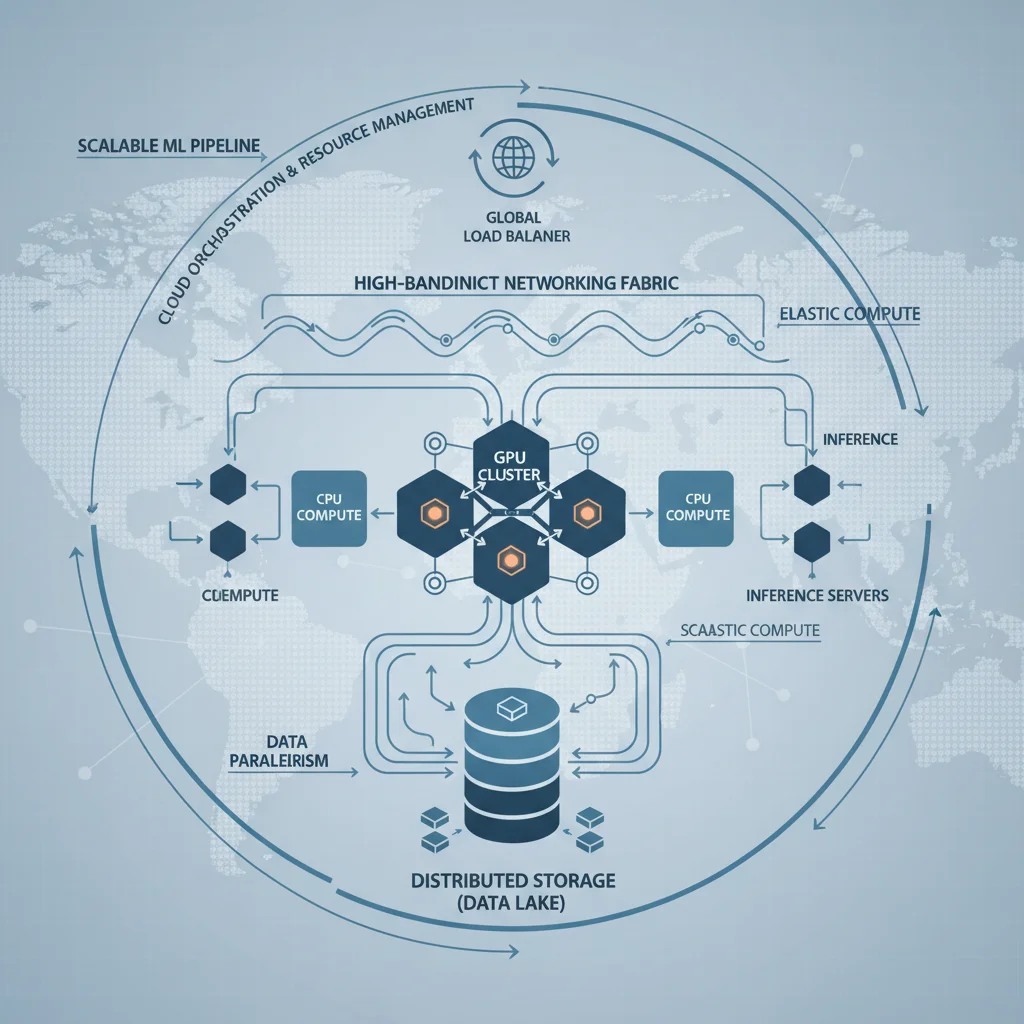
Scalability is not just about handling more data; it’s about efficiently managing growing computational demands, increasing model complexity, and expanding user bases. For US data science teams, scalability often translates to cloud-native solutions, but nuances exist.
1. Horizontal vs. Vertical Scaling
- Horizontal Scaling: Adding more machines to distribute the workload. This is typically the preferred method for ML platforms, especially in cloud environments, allowing for parallel processing of large datasets and model training.
- Vertical Scaling: Increasing the resources (CPU, RAM, GPU) of a single machine. While simpler, it has limits and can be less cost-effective for massive workloads.
A strong ML Platform Comparison 2026 will highlight platforms that excel in horizontal scaling, offering elastic compute resources that can be provisioned and de-provisioned on demand.
2. Distributed Computing Frameworks
Modern ML platforms leverage distributed computing frameworks like Apache Spark, Dask, and Ray to process and analyze data across clusters of machines. These frameworks are fundamental for:
- Big Data Processing: Handling petabytes of data for feature engineering and model training.
- Parallel Model Training: Accelerating the training of complex deep learning models using multiple GPUs.
- Hyperparameter Optimization: Running many model variations concurrently to find optimal parameters.
3. GPU and Specialized Hardware Support
For deep learning and computationally intensive tasks, GPU support is non-negotiable. Platforms should offer:
- Easy Access to GPUs: Seamless provisioning and management of GPU instances.
- Support for Specialized Hardware: Compatibility with TPUs (Tensor Processing Units) or other AI accelerators for specific workloads.
4. Serverless and Containerization Strategies
Serverless computing (e.g., AWS Lambda, Azure Functions, Google Cloud Functions) and containerization (e.g., Docker, Kubernetes) are game-changers for scalability and MLOps:
- Containerization: Packaging models and their dependencies into portable containers ensures consistency across development, testing, and production environments. Kubernetes orchestrates these containers, enabling automated scaling, healing, and deployment.
- Serverless Functions: Ideal for event-driven ML tasks, such as real-time inference or data preprocessing, as they automatically scale with demand and you only pay for actual usage.
Top ML Platforms for US Data Science Teams in 2026: A Comparative Analysis
While the market is dynamic, several platforms consistently stand out for their comprehensive features and robust scalability. Here’s a high-level ML Platform Comparison 2026 of leading contenders, focusing on their strengths and ideal use cases for US data science teams:
1. AWS SageMaker
- Strengths: Deep integration with the vast AWS ecosystem, offering unparalleled flexibility and scalability. Comprehensive suite of tools covering the entire ML lifecycle, including SageMaker Studio for IDE, Feature Store, Ground Truth for data labeling, and robust MLOps capabilities. Strong support for distributed training and a wide range of instance types (including GPUs/TPUs).
- Ideal For: Organizations heavily invested in AWS, requiring extreme scalability, deep customization, and a comprehensive, end-to-end ML platform. Teams with significant cloud engineering resources.
- Considerations: Can be complex to set up and manage for newcomers to AWS. Cost management requires careful planning.
2. Google Cloud Vertex AI
- Strengths: Unifies Google Cloud’s ML offerings into a single platform, focusing on ease of use and MLOps. Excellent AutoML capabilities, strong support for TensorFlow and PyTorch, and access to Google’s powerful TPUs. Integrates well with BigQuery for data warehousing and Google’s data analytics tools. Strong emphasis on responsible AI and explainability.
- Ideal For: Teams prioritizing ease of use, strong MLOps out-of-the-box, and leveraging Google’s cutting-edge AI research and infrastructure. Organizations already on Google Cloud.
- Considerations: While comprehensive, some specific advanced features might require deeper integration with other Google Cloud services.
3. Azure Machine Learning
- Strengths: A unified platform that integrates seamlessly with the Azure ecosystem and Microsoft’s developer tools. Offers a broad spectrum of capabilities, from low-code/no-code AutoML to advanced MLOps features. Strong enterprise-grade security, compliance, and governance. Excellent for hybrid cloud scenarios.
- Ideal For: Enterprises with existing Microsoft Azure investments, requiring robust security, compliance, and a managed service that balances ease of use with powerful capabilities.
- Considerations: Can have a steeper learning curve for teams unfamiliar with Azure’s specific terminology and architecture.
4. Databricks Lakehouse Platform (with MLflow)
- Strengths: Built on Apache Spark, making it exceptionally powerful for big data processing and distributed ML. MLflow provides an open-source platform for ML lifecycle management (experiment tracking, reproducible runs, model deployment). The Lakehouse architecture unifies data warehousing and data lakes, simplifying data pipelines for ML.
- Ideal For: Organizations dealing with massive, diverse datasets and requiring strong data engineering capabilities alongside ML. Teams comfortable with Spark and open-source tools.
- Considerations: While powerful, it requires a solid understanding of Spark and distributed computing. MLOps capabilities are strong but might require more configuration compared to fully managed end-to-end platforms.
5. DataRobot
- Strengths: Focuses heavily on automated machine learning (AutoML) and MLOps, making it very user-friendly for both data scientists and business analysts. Provides strong model governance, explainability, and bias detection out-of-the-box. Accelerates time-to-value for many use cases.
- Ideal For: Businesses looking to rapidly build, deploy, and manage ML models with a strong emphasis on automation and responsible AI. Teams with varying levels of ML expertise.
- Considerations: While powerful for many tasks, it might offer less flexibility for highly customized, research-oriented ML projects compared to cloud-native platforms.
Strategic Considerations for US Data Science Teams
Beyond features and scalability, several strategic factors should influence your ML Platform Comparison 2026:
1. Open Source vs. Commercial Platforms
- Open Source: Offers flexibility, community support, and avoids vendor lock-in. However, it often requires more internal resources for setup, maintenance, and MLOps. Examples include Kubeflow, MLflow (often used within commercial platforms), and raw framework usage.
- Commercial/Managed Platforms: Provide end-to-end solutions, reduced operational overhead, and dedicated vendor support. They come with licensing costs and potential vendor lock-in, but often accelerate time-to-market.
Many organizations adopt a hybrid approach, leveraging open-source tools within a managed cloud environment.
2. Vendor Lock-in and Portability
Consider the ease of migrating your models and data if you decide to switch platforms. Platforms that support open standards (e.g., ONNX for model interchange, Docker for containers) offer greater portability.
3. Cost Management and ROI
The total cost of ownership (TCO) includes not just licensing fees but also compute costs, storage, data egress, and the cost of human resources for management. Evaluate how each platform helps optimize these costs. Look for detailed pricing models and cost-optimization features.
4. Compliance and Regulatory Requirements (US Specific)
For US data science teams, especially in regulated industries (healthcare, finance), compliance with regulations like HIPAA, GDPR (for global operations), CCPA, and industry-specific standards is paramount. Ensure the chosen platform offers:
- Data Residency: The ability to store and process data within specific geographic regions (e.g., US-based data centers).
- Security Certifications: Compliance with industry security standards (e.g., ISO 27001, SOC 2).
- Audit Trails & Governance: Comprehensive logging and auditing capabilities to demonstrate compliance.
5. Talent Availability and Learning Curve
Consider your team’s existing skill set. A platform that aligns with your team’s expertise can accelerate adoption. Conversely, a platform with a steep learning curve might require significant training investment.
The Future of ML Platforms: Trends to Watch in 2026 and Beyond
As you undertake your ML Platform Comparison 2026, keep an eye on these emerging trends:
- Generative AI Integration: More platforms will integrate generative AI capabilities (e.g., large language models, image generation) directly into their offerings, allowing data scientists to leverage these powerful models for various tasks.
- Low-Code/No-Code AI: The demand for democratizing AI will continue to grow, leading to more intuitive visual interfaces and automated workflows for non-expert users.
- Edge AI Deployment: As AI moves closer to the data source, platforms will enhance capabilities for deploying, monitoring, and managing models on edge devices.
- Responsible AI Tools: Emphasis on fairness, accountability, transparency, and ethics in AI will drive the development of more sophisticated tools for bias detection, explainability, and governance.
- Federated Learning: For privacy-sensitive applications, platforms will increasingly support federated learning, allowing models to be trained on decentralized datasets without centralizing raw data.
Conclusion: Making Your Informed Decision
Choosing the right ML platform in 2026 is a strategic decision that will profoundly impact the efficiency, innovation, and success of your US data science team. It’s not a one-size-fits-all solution. Your selection process should involve:
- Detailed Needs Assessment: Clearly define your team’s current and future requirements, use cases, and constraints.
- Pilot Projects: Conduct proof-of-concept projects on a shortlist of platforms to evaluate their real-world performance and user experience.
- Cost-Benefit Analysis: Thoroughly assess the total cost of ownership against the anticipated benefits and ROI.
- Scalability and Future-Proofing: Ensure the platform can grow with your organization and adapt to evolving technological demands.
- Team Feedback: Involve your data scientists and MLOps engineers in the evaluation process.
By meticulously weighing the features, scalability, and strategic implications discussed in this ML Platform Comparison 2026, US data science teams can confidently select a platform that empowers them to build, deploy, and manage cutting-edge AI solutions, driving innovation and delivering tangible business value well into the future.