ROI of Cloud Migration: A 12-Month Financial Projection for U.S. Enterprises in 2026 (FINANCIAL IMPACT)

ROI of Cloud Migration: A 12-Month Financial Projection for U.S. Enterprises in 2026 (FINANCIAL IMPACT)
In the rapidly evolving digital landscape, U.S. enterprises are constantly seeking avenues to enhance operational efficiency, reduce costs, and foster innovation. Cloud migration stands out as a pivotal strategy in achieving these objectives. However, the decision to embark on such a transformative journey is often met with skepticism and a demand for tangible financial justification. This article delves deep into the projected cloud migration ROI for U.S. enterprises over a 12-month horizon in 2026, providing a comprehensive financial projection that highlights the significant benefits and strategic imperatives. Understanding the financial impact of moving to the cloud is not just about cutting costs; it’s about investing in a future-proof, agile, and scalable infrastructure that drives sustained growth and competitive advantage.
The concept of Return on Investment (ROI) in cloud migration is multifaceted. It encompasses direct cost savings, such as reduced hardware expenditure and lower energy bills, as well as indirect benefits like increased productivity, faster time-to-market for new products, and enhanced data security. For enterprises contemplating this transition, a clear financial roadmap is indispensable. We will explore various facets of this projection, including initial investment considerations, anticipated cost reductions, revenue generation opportunities, and the often-underestimated value of improved business agility. By focusing on a 12-month period, we aim to provide a realistic and actionable financial outlook for decision-makers in 2026.
Understanding the Initial Investment in Cloud Migration
Before delving into the returns, it’s crucial to acknowledge the upfront investment required for a successful cloud migration. This isn’t merely about subscribing to a cloud service; it involves a series of strategic expenditures that lay the groundwork for future gains. The initial costs can be broadly categorized into several key areas, each playing a vital role in determining the overall cloud migration ROI.
Assessment and Planning
The very first step involves a thorough assessment of existing infrastructure, applications, and data. This phase typically includes:
- Discovery Tools and Services: Investing in tools that map dependencies and analyze current resource utilization.
- Consulting Services: Engaging experts to define migration strategies, choose the right cloud provider (AWS, Azure, Google Cloud, etc.), and design the target architecture.
- Personnel Training: Upskilling internal IT teams to manage and optimize cloud environments. This is a critical investment that often pays dividends in the long run by reducing reliance on external consultants.
These planning stages, while seemingly expensive, are crucial for mitigating risks and ensuring a smooth transition, directly impacting the eventual cloud migration ROI.
Migration Execution Costs
The actual process of moving applications and data to the cloud incurs significant costs:
- Data Transfer: Moving large volumes of data can incur egress fees, though many cloud providers offer incentives or reduced costs for initial data ingress.
- Application Refactoring/Re-platforming: Some legacy applications may need significant modifications to run optimally in a cloud environment. This can be a substantial cost, but it also presents an opportunity to modernize and improve application performance.
- Temporary Dual Operations: During the migration, enterprises might run both on-premises and cloud environments simultaneously, leading to temporary duplicate operational costs.
- Licensing Adjustments: Software licenses may need to be renegotiated or adapted for cloud usage models.
Careful budgeting and phased migration strategies can help manage these expenditures and keep the financial projection for cloud migration ROI on track.
Security and Compliance
Cloud security is paramount, and initial investments are often needed to establish robust security postures:
- Security Tools and Services: Implementing cloud-native security solutions, identity and access management (IAM), and compliance monitoring tools.
- Compliance Audits: Ensuring that the cloud environment meets industry-specific regulatory requirements.
While these are initial costs, they contribute to risk reduction and build trust, which indirectly enhances the long-term cloud migration ROI.
Projected Cost Savings: The Immediate Financial Impact
One of the most compelling arguments for cloud migration is the promise of significant cost savings. Over a 12-month period in 2026, U.S. enterprises can expect to see a substantial reduction in various operational expenditures. These savings form the bedrock of a positive cloud migration ROI.
Infrastructure and Hardware Costs
The most direct savings come from eliminating the need to purchase, maintain, and upgrade physical hardware. This includes:
- Reduced Capital Expenditure (CapEx): Shifting from buying servers, storage, and networking equipment to an operational expenditure (OpEx) model, where resources are consumed as a service. This frees up capital for other strategic investments.
- Lower Maintenance Costs: Cloud providers handle all hardware maintenance, repairs, and upgrades, eliminating the need for internal teams to perform these tasks or for costly service contracts.
- Decreased Depreciation: Assets no longer depreciate on the balance sheet, simplifying financial reporting and improving asset utilization metrics.
Operational Efficiency and Staffing
Cloud environments automate many routine IT tasks, leading to efficiency gains:
- Reduced Data Center Costs: Lowering expenses associated with power, cooling, physical security, and real estate for on-premises data centers.
- Optimized IT Staff Utilization: IT personnel can shift from maintenance tasks to more strategic initiatives like innovation, development, and business process optimization. While this may not always translate to direct headcount reduction, it significantly increases the value derived from existing staff, positively impacting cloud migration ROI.
- Automated Management: Cloud platforms offer extensive automation capabilities for deployment, scaling, and monitoring, reducing manual effort and potential for human error.
Energy Consumption and Environmental Impact
While often overlooked in direct financial projections, the reduction in energy consumption is a tangible saving, especially for large data centers. Cloud providers operate at massive scale, achieving economies of scale in energy efficiency that individual enterprises cannot match. This also contributes to corporate sustainability goals, which can have positive brand and reputational benefits, indirectly boosting cloud migration ROI.
Enhanced Business Value: Beyond Direct Savings
The true power of cloud migration extends beyond mere cost reduction. Over a 12-month period, U.S. enterprises will begin to realize significant enhancements in business value, contributing substantially to the overall cloud migration ROI. These benefits are often harder to quantify but are critical for long-term success.
Increased Agility and Scalability
The ability to rapidly scale resources up or down based on demand is a cornerstone of cloud computing. This agility translates into:
- Faster Time-to-Market: Developers can provision resources instantly, accelerating the development, testing, and deployment of new applications and services. This allows businesses to respond more quickly to market changes and seize new opportunities.
- Optimized Resource Utilization: Pay-as-you-go models ensure that enterprises only pay for the resources they consume, avoiding over-provisioning and under-utilization that are common in on-premises environments. This flexibility directly impacts profitability and improves the cloud migration ROI.
- Seasonal Demand Management: Businesses experiencing seasonal peaks can easily scale up during busy periods and scale down during troughs, optimizing costs and maintaining performance.
Improved Innovation and Competitive Advantage
Cloud platforms offer access to a vast array of cutting-edge technologies that would be prohibitively expensive or complex to implement on-premises. This includes:
- Advanced Analytics and AI/ML: Leveraging cloud-native services for big data analytics, machine learning, and artificial intelligence can unlock deeper insights into customer behavior, optimize operations, and create new revenue streams.
- Serverless Computing: Adopting serverless architectures allows developers to focus purely on code, abstracting away infrastructure management and accelerating innovation cycles.
- Global Reach: Cloud infrastructure allows enterprises to deploy applications and services closer to their global customer base, reducing latency and improving user experience, thereby expanding market reach and competitive edge.
These capabilities foster a culture of innovation, enabling enterprises to stay ahead of the competition and significantly boost their long-term cloud migration ROI.
Enhanced Disaster Recovery and Business Continuity
Cloud providers offer robust disaster recovery (DR) solutions that are often more affordable and reliable than traditional on-premises DR strategies. This includes:
- Automated Backups and Redundancy: Data is automatically replicated across multiple availability zones, ensuring high availability and protection against data loss.
- Faster Recovery Times: In the event of an outage, cloud-based DR can restore operations much faster, minimizing downtime and its associated financial losses.
- Reduced DR Costs: Eliminating the need for a secondary physical data center specifically for disaster recovery translates into substantial savings.
The peace of mind and reduced risk associated with superior DR capabilities contribute significantly to the intangible, yet invaluable, aspects of cloud migration ROI.
Quantifying the 12-Month Financial Projection for 2026
To provide a concrete financial projection, let’s consider a hypothetical U.S. enterprise with moderate IT infrastructure embarking on a comprehensive cloud migration in early 2026. While exact figures will vary widely based on size, industry, and migration complexity, this model aims to illustrate the typical trajectory of cloud migration ROI.
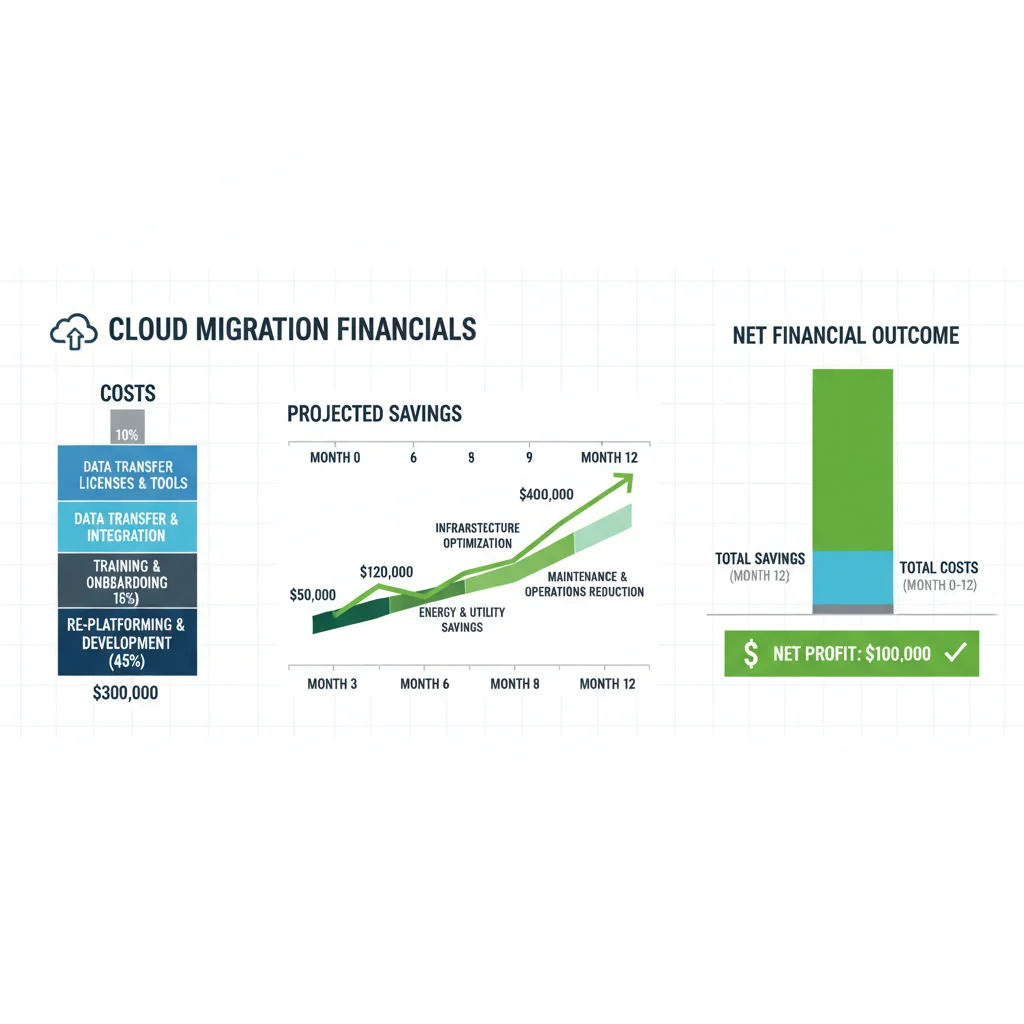
Month 1-3: Initial Investment & Setup
- Costs: High. This period sees significant expenditure on assessment, planning, consulting, initial training, and data transfer. Application refactoring might also begin.
- Savings: Minimal. On-premises infrastructure is still largely operational.
- Net Impact: Negative cash flow as investments are made.
Month 4-6: Phased Migration & Early Optimization
- Costs: Moderate to High. Migration of core applications continues. Cloud infrastructure costs begin to accrue.
- Savings: Emerging. Initial decommissioning of some on-premises hardware might occur, leading to small savings in power, cooling, and maintenance. Early cloud resource optimization efforts begin to yield results.
- Net Impact: Still likely negative, but the rate of burn decreases as initial savings start to offset ongoing migration costs. The enterprise is building momentum towards positive cloud migration ROI.
Month 7-9: Accelerating Savings & Operational Shift
- Costs: Moderate. Major migration phases are completed. Focus shifts to optimizing cloud spend and further application modernization.
- Savings: Significant. Substantial portions of on-premises infrastructure are decommissioned. Reduced operational overhead becomes more apparent. Improved IT staff efficiency starts to manifest.
- Net Impact: Approaching break-even or slightly positive. The cumulative savings begin to catch up with the cumulative investment, signaling a turning point for cloud migration ROI.
Month 10-12: Realizing Full Potential & Positive ROI
- Costs: Low to Moderate. Primarily ongoing cloud consumption and continuous optimization.
- Savings: Maximized. On-premises infrastructure is largely retired. Full benefits of reduced CapEx, OpEx, and improved efficiency are realized.
- Net Impact: Strongly positive. The enterprise is now experiencing clear positive cash flow from its cloud investment. The strategic benefits of agility, innovation, and enhanced security are fully operational, contributing to a robust cloud migration ROI.
By the end of 12 months, a well-executed cloud migration is projected to demonstrate a tangible positive ROI for most U.S. enterprises. This isn’t just about recovering the initial investment but about generating new value that was previously unattainable.

Key Factors Influencing Cloud Migration ROI
While the projection above provides a general roadmap, several critical factors can significantly influence the actual cloud migration ROI experienced by an enterprise:
Migration Strategy
- Lift-and-Shift vs. Re-platforming/Refactoring: A ‘lift-and-shift’ (rehosting) approach is generally faster and cheaper initially but may not yield optimal long-term cloud benefits. Re-platforming or refactoring applications for the cloud can be more expensive upfront but unlock greater cost savings, performance, and scalability, leading to a higher long-term cloud migration ROI.
- Phased vs. Big Bang: A phased migration reduces risk and allows for continuous learning and optimization, often leading to a smoother financial curve.
Cloud Provider Choice
Each major cloud provider (AWS, Azure, Google Cloud) offers different pricing models, services, and support. Choosing the provider that best aligns with an enterprise’s specific needs and existing technology stack is crucial for optimizing costs and maximizing cloud migration ROI.
Resource Optimization and Governance
Cloud environments require continuous monitoring and optimization to prevent ‘cloud sprawl’ and ensure cost efficiency. Implementing robust cloud governance policies, utilizing cost management tools, and regularly right-sizing resources are essential for sustaining a positive cloud migration ROI.
Organizational Readiness and Culture
The success of cloud migration is not solely a technical endeavor. An organization’s ability to adapt, train its workforce, and embrace new operational models plays a significant role. A culture that encourages innovation and continuous improvement in cloud usage will naturally see a higher cloud migration ROI.
Data Governance and Security
Proactive data governance and a strong security framework from the outset can prevent costly breaches and compliance penalties, safeguarding the financial benefits of cloud adoption and ensuring a positive cloud migration ROI.
Mitigating Risks and Maximizing Returns
To ensure the projected cloud migration ROI is realized, enterprises must proactively address potential pitfalls and implement best practices:
Comprehensive Planning
A detailed assessment of current infrastructure, clear definition of migration goals, and a well-articulated strategy are non-negotiable. This includes identifying applications suitable for cloud, those needing modernization, and those best left on-premises (hybrid cloud strategy).
Vendor Lock-in Avoidance
While deep integration with a single cloud provider can offer benefits, it’s wise to consider multi-cloud or hybrid cloud strategies to maintain flexibility and avoid excessive vendor dependence. This strategic foresight can protect future cloud migration ROI.
Cost Management and FinOps
Implementing a FinOps (Cloud Financial Operations) framework is crucial. This involves a cultural practice and operational framework that brings financial accountability to the variable spend model of cloud, enabling organizations to make business trade-offs between speed, cost, and quality. Continuous monitoring of cloud spend, identifying idle resources, and leveraging reserved instances or spot instances can significantly optimize costs.
Security First Approach
Security should be embedded at every stage of the migration and ongoing cloud operations, not as an afterthought. Regular security audits, penetration testing, and adherence to compliance standards are vital to protect data and maintain trust.
Continuous Optimization
The cloud journey is not a one-time event but an ongoing process. Regular reviews of cloud architecture, performance, and cost are necessary to ensure resources are always optimized and aligned with business needs. This continuous improvement loop directly contributes to maximizing the cloud migration ROI.
The Strategic Imperative for U.S. Enterprises in 2026
For U.S. enterprises looking towards 2026, cloud migration is no longer an option but a strategic imperative. The financial projections clearly indicate that while there’s an initial investment, the returns over a 12-month period are substantial, encompassing both direct cost savings and significant enhancements in business value. The ability to innovate faster, scale with demand, improve disaster recovery, and leverage advanced technologies provides a formidable competitive advantage.
The landscape of 2026 will be defined by agility, data-driven decision-making, and resilience. Enterprises that embrace cloud migration strategically will be better positioned to navigate market uncertainties, capitalize on emerging opportunities, and achieve sustainable growth. The cloud migration ROI is not just a financial metric; it’s a testament to an organization’s commitment to modernization, efficiency, and future readiness.
In conclusion, the detailed 12-month financial projection for cloud migration in 2026 paints a clear picture: U.S. enterprises can expect a robust and positive return on their investment. By carefully planning, executing, and optimizing their cloud journey, businesses can unlock unparalleled financial and strategic benefits, solidifying their position in a competitive global economy. The time to invest in the cloud is now, with a clear vision for the significant financial impact it will bring.