Robotics Innovations: Boosting US Manufacturing Efficiency by 15% by 2026
Robotics Innovations: Boosting US Manufacturing Efficiency by 15% by 2026
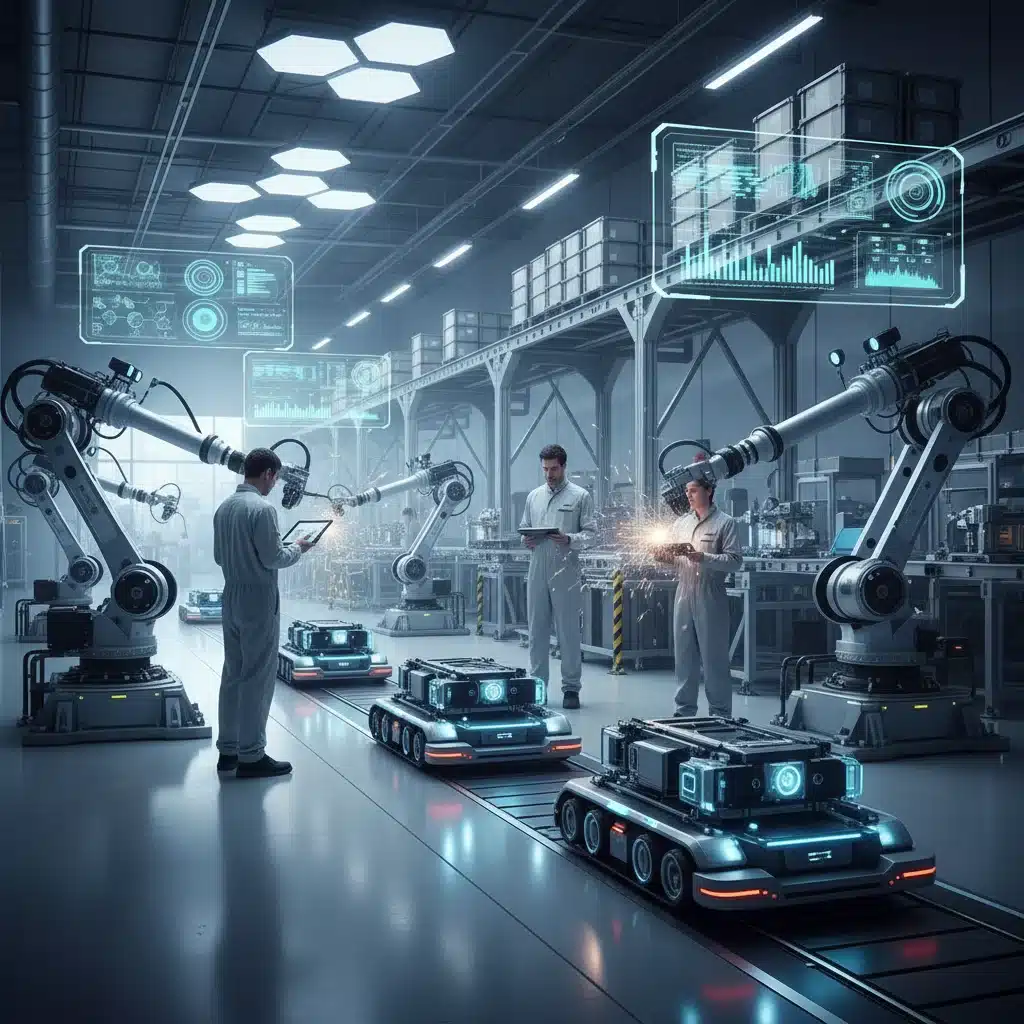
The landscape of US manufacturing is undergoing a profound transformation, driven by an accelerating wave of robotics innovations. As industries worldwide grapple with demands for higher productivity, reduced costs, and enhanced quality, advanced robotics are emerging as the linchpin for achieving these goals. Projections indicate that these cutting-edge technologies are poised to deliver a remarkable 15% increase in efficiency across US manufacturing by 2026, fundamentally reshaping how goods are produced and delivered.
This isn’t just about replacing human labor; it’s about augmenting human capabilities, creating safer work environments, and unlocking unprecedented levels of precision and scalability. From the smallest components to the largest assemblies, robotics are redefining every stage of the manufacturing process. The integration of artificial intelligence, machine learning, and advanced sensor technology is enabling robots to perform tasks with greater autonomy, adaptability, and intelligence than ever before. This article delves into the five most impactful robotics innovations that are driving this projected surge in US manufacturing efficiency, exploring their mechanisms, benefits, and the transformative potential they hold for the industrial sector.
The Urgent Need for Robotics Manufacturing Efficiency in the US
For decades, US manufacturing has faced significant challenges, including rising labor costs, global competition, and the need for greater agility in response to market fluctuations. The COVID-19 pandemic further exposed vulnerabilities in supply chains and highlighted the critical importance of domestic production capabilities. In this context, enhancing robotics manufacturing efficiency is not merely an advantage; it’s a strategic imperative.
Boosting efficiency by 15% within the next three years represents a monumental shift. This isn’t a speculative figure but one grounded in the rapid advancements in robotics and automation. Increased efficiency translates directly into lower production costs, faster time-to-market, improved product quality, and the ability to scale operations rapidly. It also enables manufacturers to re-shore production, reducing reliance on overseas supply chains and bolstering national economic resilience. The integration of advanced robotics allows for continuous operation, minimizes human error, and facilitates the handling of dangerous or repetitive tasks, thereby improving worker safety and job satisfaction. Furthermore, highly automated factories can adapt more quickly to design changes and customized orders, offering a competitive edge in a consumer-driven market.
This transformation is not just about the robots themselves, but the ecosystems they create. Smart factories, powered by IoT (Internet of Things) and AI, are becoming the norm, where every machine, sensor, and robot communicates to optimize the entire production flow. This interconnectedness allows for predictive maintenance, real-time quality control, and dynamic resource allocation, all contributing to unprecedented levels of operational efficiency. The drive for robotics manufacturing efficiency is therefore a holistic strategy, encompassing technology, process optimization, and workforce development.
1. Advanced AI-Powered Vision Systems and Machine Learning
One of the most significant leaps in robotics manufacturing efficiency comes from the integration of advanced AI-powered vision systems coupled with machine learning algorithms. Traditional robotic vision systems could perform basic object recognition and positioning, but their capabilities were limited by pre-programmed rules and environmental constraints. Today, AI has revolutionized this, allowing robots to ‘see,’ ‘understand,’ and ‘learn’ from their surroundings with remarkable sophistication.
How They Work:
- Deep Learning for Object Recognition: AI models, trained on vast datasets of images and videos, can identify and classify objects with incredible accuracy, even in complex, unstructured environments. This includes recognizing defects, distinguishing between subtly different parts, and accurately picking items from bins.
- Adaptive Path Planning: Machine learning enables robots to adapt their movements and gripping strategies in real-time based on visual feedback. If an object is slightly misplaced or deformed, the robot can adjust its approach without human intervention.
- Quality Control and Inspection: AI vision systems can perform ultra-fast and highly accurate quality inspections, detecting microscopic flaws or inconsistencies that would be impossible for the human eye to spot. They can compare manufactured parts against CAD models and flag deviations instantly.
- Predictive Maintenance: By analyzing visual data from machinery, AI can detect early signs of wear and tear or impending malfunctions, allowing for proactive maintenance before costly breakdowns occur.
Impact on Efficiency:
The impact on robotics manufacturing efficiency is profound. These systems drastically reduce inspection times, minimize waste from defective products, and increase throughput by enabling robots to handle greater variability in tasks. They also reduce the need for specialized jigs and fixtures, making production lines more flexible and adaptable to different product lines. For instance, a robot equipped with AI vision can sort thousands of tiny electronic components per minute, far exceeding human speed and consistency. The ability to learn and improve over time means these systems become more efficient the longer they operate, contributing significantly to the projected 15% efficiency gain.
2. Collaborative Robots (Cobots) for Enhanced Human-Robot Interaction
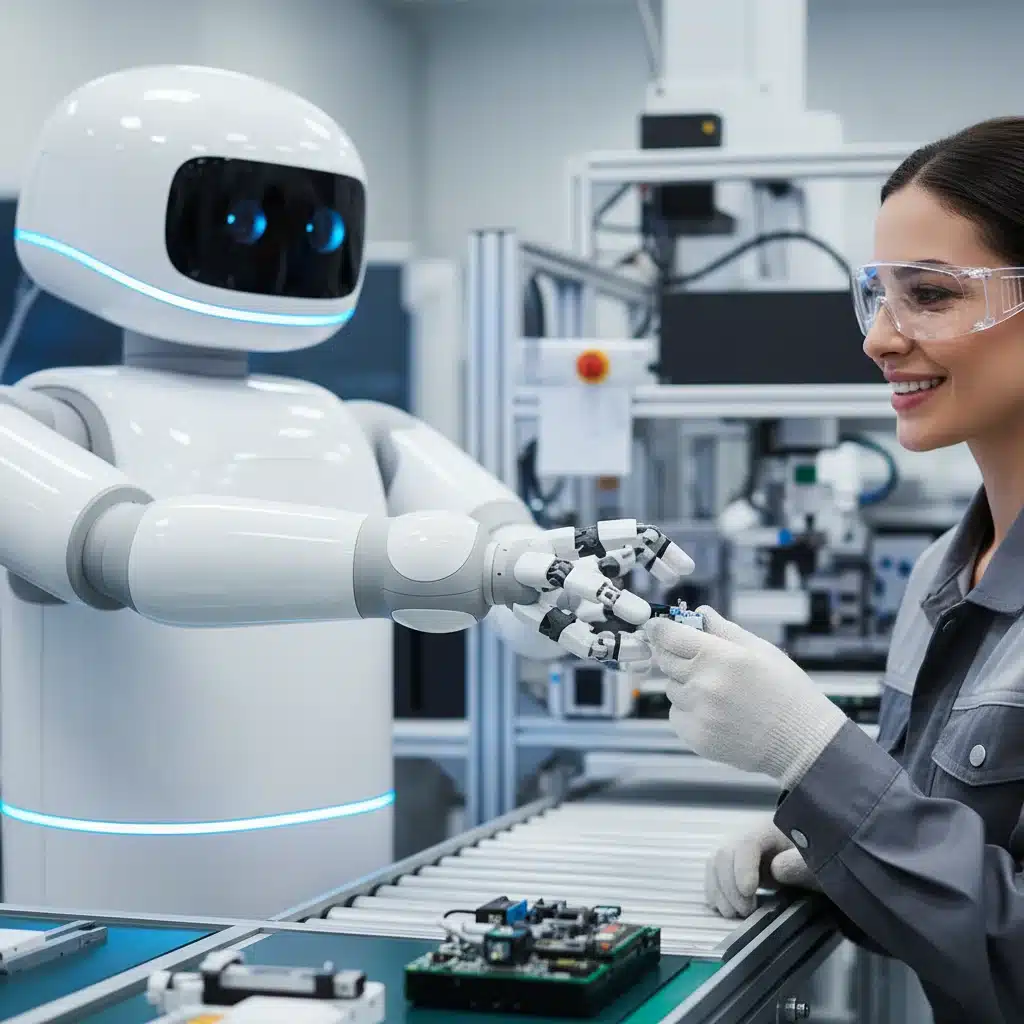
The rise of collaborative robots, or cobots, marks a pivotal shift from traditional industrial robots that operated in cages, isolated from human workers. Cobots are designed to work safely alongside humans, sharing the same workspace and performing tasks in concert. This innovation is not about replacing humans but rather augmenting their capabilities and improving overall robotics manufacturing efficiency.
Key Features and Benefits:
- Safety Features: Cobots are equipped with advanced sensors, force-torque limiters, and sophisticated programming that allow them to detect human presence and stop or slow down to prevent collisions. This eliminates the need for extensive safety guarding, simplifying factory layouts.
- Ease of Programming: Many cobots can be programmed through ‘lead-through’ methods, where an operator physically guides the robot arm through a sequence of movements. This intuitive programming reduces setup times and allows non-experts to deploy and redeploy cobots quickly.
- Flexibility and Adaptability: Cobots are highly versatile and can be easily moved and re-tasked for different applications. This makes them ideal for high-mix, low-volume production environments where flexibility is paramount.
- Ergonomic Assistance: They can handle repetitive, strenuous, or ergonomically challenging tasks, reducing the physical burden on human workers and decreasing the risk of injuries. This allows human workers to focus on more complex, value-added activities that require cognitive skills.
Transforming Workflows:
The integration of cobots fundamentally alters manufacturing workflows. A human worker might perform a delicate assembly task while a cobot handles the heavy lifting, precise screwing, or repetitive picking and placing of components. This division of labor leverages the strengths of both humans and robots, leading to significant boosts in robotics manufacturing efficiency. For example, in electronics assembly, a cobot can precisely place components on a circuit board while a human performs soldering and final inspection, resulting in faster production cycles and higher quality output. This collaborative approach fosters a more dynamic and productive manufacturing environment, directly contributing to the projected efficiency gains.
3. Autonomous Mobile Robots (AMRs) for Intralogistics Optimization
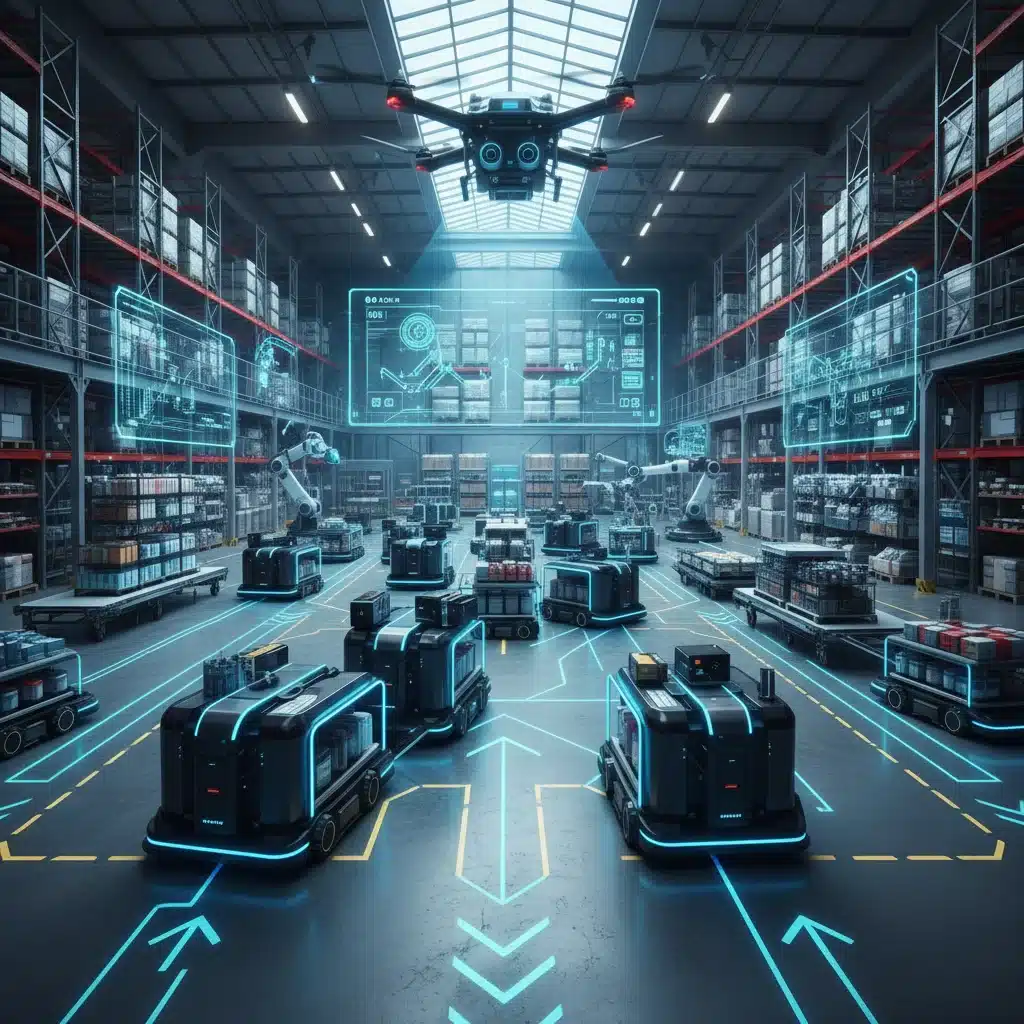
Beyond the assembly line, the internal logistics of a factory – moving materials, components, and finished goods – often represent a significant bottleneck in manufacturing efficiency. Autonomous Mobile Robots (AMRs) are revolutionizing this aspect, transforming factories into highly dynamic and optimized environments, significantly impacting robotics manufacturing efficiency.
How AMRs Enhance Logistics:
- Dynamic Navigation: Unlike traditional Automated Guided Vehicles (AGVs) that follow fixed paths (e.g., magnetic strips), AMRs use sophisticated sensors (LiDAR, cameras, ultrasonic) and AI algorithms to build maps of their environment and navigate autonomously. They can detect obstacles (people, forkllifts, other robots) and dynamically reroute themselves, ensuring continuous flow without interruption.
- Flexible Material Transport: AMRs can transport raw materials to production lines, move work-in-progress between stations, and carry finished products to warehousing or shipping areas. They can be integrated with existing infrastructure and scale up or down based on demand.
- Inventory Management: Some AMRs are equipped with scanning capabilities, allowing them to perform real-time inventory checks as they move through a facility. This provides accurate, up-to-date data, reducing errors and optimizing stock levels.
- Integration with WMS/MES: AMRs are often integrated with Warehouse Management Systems (WMS) and Manufacturing Execution Systems (MES), receiving tasks and reporting status in real-time. This creates a fully synchronized and optimized intralogistics system.
Efficiency Gains:
The deployment of AMRs leads to dramatic improvements in robotics manufacturing efficiency by reducing manual labor for material handling, minimizing bottlenecks, and ensuring a steady flow of materials to where they are needed, precisely when they are needed. This ‘just-in-time’ delivery reduces inventory holding costs, optimizes floor space, and speeds up overall production cycles. Companies report significant reductions in material handling costs and faster throughput times after implementing AMRs. Their ability to operate 24/7 without breaks further enhances productivity and contributes directly to the overall efficiency boost in US manufacturing.
4. Advanced Gripping and Dexterity Solutions
For a long time, robotic manipulation was limited by the capabilities of their end-effectors, primarily simple two-finger grippers. However, recent advancements in gripping technology and robotic dexterity are unlocking new possibilities for automation, directly contributing to increased robotics manufacturing efficiency.
Innovations in Gripping:
- Soft Robotics and Compliant Grippers: These grippers, often made from flexible materials like silicone, can conform to the shape of irregular or delicate objects. They reduce the risk of damage to fragile parts and can handle a wider variety of items without requiring complex retooling.
- Multi-fingered and Dexterous Hands: Inspired by the human hand, these advanced grippers offer multiple degrees of freedom and a high level of dexterity. They can manipulate complex shapes, perform intricate assembly tasks, and even handle tools with precision.
- Vacuum and Magnetic Grippers: Specialized grippers for specific materials, such as vacuum cups for flat, smooth surfaces (e.g., glass, sheet metal) or magnetic grippers for ferrous metals, are becoming more sophisticated and adaptable.
- Sensor Integration: Modern grippers often integrate force-torque sensors and tactile feedback, allowing the robot to ‘feel’ the object it’s holding. This enables adaptive gripping pressure, preventing crushing delicate items or dropping slippery ones.
Impact on Manufacturing:
These gripping innovations significantly expand the range of tasks that can be automated, from handling highly sensitive electronic components to assembling intricate mechanical parts. They reduce changeover times between different product lines, as a single gripper might be able to handle multiple part variations. The increased dexterity means robots can perform more complex assembly tasks that previously required human fine motor skills, leading to higher precision and reduced error rates. This directly translates into improved product quality and a substantial boost in robotics manufacturing efficiency, making automation viable for a broader spectrum of manufacturing processes.
5. Digital Twin Technology and Cloud Robotics
The convergence of digital twin technology and cloud robotics is creating a new paradigm for optimizing manufacturing operations, promising significant gains in robotics manufacturing efficiency. These innovations allow for virtual testing, real-time monitoring, and remote management of robotic systems.
Understanding the Technologies:
- Digital Twin: A digital twin is a virtual replica of a physical robot, a production line, or an entire factory. It’s fed with real-time data from sensors on the physical assets, allowing for accurate simulation and prediction of behavior. Manufacturers can test new configurations, optimize robot movements, and simulate production scenarios in the virtual world before deploying them physically, minimizing risks and downtime.
- Cloud Robotics: This involves connecting robots to a centralized cloud infrastructure. The cloud provides vast computational power, allowing robots to offload complex processing tasks (like AI model training or path planning) to powerful servers. It also enables robots to share data, learn from each other’s experiences, and receive updates and new functionalities remotely.
Synergistic Benefits for Efficiency:
The combination of digital twins and cloud robotics offers unparalleled advantages for robotics manufacturing efficiency. With digital twins, manufacturers can:
- Optimize Robot Programming: Develop and refine robot programs in a simulated environment, reducing commissioning times and preventing errors on the physical line.
- Predictive Maintenance: Monitor the health of robots and machinery in real-time through their digital twins, predicting potential failures and scheduling maintenance proactively, thus avoiding costly unscheduled downtime.
- Process Optimization: Simulate different production layouts, robot assignments, and task sequences to identify the most efficient configurations before physical implementation.
Cloud robotics, on the other hand, allows for:
- Collective Learning: Robots can share data and learned behaviors, accelerating the deployment of new capabilities across an entire fleet.
- Centralized Management: Remote monitoring, diagnostics, and troubleshooting of robots from anywhere, reducing the need for on-site technicians.
- Scalable AI: Access to powerful AI algorithms and processing capabilities in the cloud, enabling more sophisticated decision-making and adaptability for individual robots.
This integrated approach leads to faster deployment of new production lines, continuous improvement of existing processes, and a significant reduction in operational costs, all contributing to the projected 15% efficiency boost for US manufacturing.
The Broader Impact on US Manufacturing and Workforce
The 15% increase in robotics manufacturing efficiency by 2026 is not merely a statistical projection; it represents a fundamental shift in the competitiveness and capabilities of US industry. This surge in efficiency will have far-reaching implications, impacting everything from global market share to the nature of work itself.
Economic Competitiveness:
Higher efficiency means lower production costs per unit, making US-manufactured goods more competitive on the global stage. This can lead to increased exports, a stronger domestic industrial base, and a reduced trade deficit. The ability to produce high-quality goods at competitive prices will attract more investment into the US manufacturing sector, creating a virtuous cycle of innovation and growth.
Resilience and Agility:
Automated and AI-driven factories are inherently more resilient to disruptions. They can adapt to supply chain shocks, labor shortages, and sudden shifts in demand with greater ease. The flexibility offered by robotics allows manufacturers to quickly retool for new products or customize existing ones, providing an agile response to dynamic market conditions.
Workforce Transformation:
While concerns about job displacement often arise, the reality is a transformation of the workforce, not its elimination. Repetitive, dangerous, and physically demanding tasks will increasingly be handled by robots, freeing human workers to focus on higher-value activities such such as:
- Robot programming and maintenance: A new class of skilled technicians will be needed to manage and maintain complex robotic systems.
- Data analysis and optimization: Humans will interpret the vast amounts of data generated by smart factories to drive continuous improvement.
- Creative problem-solving: Tasks requiring critical thinking, innovation, and complex decision-making will remain firmly in the human domain.
- Human-robot collaboration management: Overseeing and optimizing collaborative workflows between humans and cobots.
This shift necessitates significant investment in workforce training and education to equip the next generation of manufacturing professionals with the skills required for the automated factory. The focus will be on upskilling and reskilling programs that bridge the gap between traditional manufacturing roles and the demands of advanced robotics. The ultimate goal is to create more engaging, safer, and intellectually stimulating jobs within the sector.
Challenges and Considerations
Achieving a 15% increase in robotics manufacturing efficiency by 2026 is an ambitious goal, and it comes with its own set of challenges that need to be addressed:
- Initial Investment Costs: Implementing advanced robotics and AI systems can require substantial upfront capital investment, which might be a barrier for smaller manufacturers.
- Integration Complexity: Integrating new robotic systems with legacy equipment and existing IT infrastructure can be complex and time-consuming.
- Cybersecurity Risks: Highly connected smart factories are more vulnerable to cyberattacks, necessitating robust cybersecurity measures.
- Skill Gap: The need for a skilled workforce capable of deploying, managing, and maintaining these advanced systems requires significant educational and training initiatives.
- Ethical Considerations: As AI and robotics become more autonomous, ethical considerations regarding decision-making, accountability, and the impact on society will become increasingly important.
- Standardization: Lack of universal standards for interoperability between different robotic systems and software platforms can hinder seamless integration and scaling.
Addressing these challenges will require collaborative efforts between government, industry, and academia. Policy support, funding for R&D, and the development of standardized protocols will be crucial in accelerating the adoption and maximizing the benefits of these robotics innovations.
Conclusion: A New Era for US Manufacturing
The journey towards a 15% increase in robotics manufacturing efficiency by 2026 is well underway, powered by transformative innovations in AI-powered vision systems, collaborative robots, autonomous mobile robots, advanced gripping solutions, and the strategic deployment of digital twin technology and cloud robotics. These advancements are not just incremental improvements; they represent a fundamental paradigm shift in how US manufacturers operate, compete, and innovate.
By embracing these cutting-edge technologies, US manufacturing is poised to become more productive, resilient, and competitive on a global scale. The benefits extend beyond the factory floor, contributing to economic growth, job creation (in new categories), and enhanced national security through a stronger domestic industrial base. While challenges remain, the clear trajectory of technological progress and the strategic imperative for efficiency ensure that robotics will continue to be at the forefront of this industrial revolution. The future of US manufacturing is undeniably robotic, intelligent, and highly efficient, promising a new era of prosperity and innovation for the nation.