US Battery Innovations: 40% Energy Boost by 2027 – Latest Updates
The quest for more efficient, sustainable, and powerful energy storage solutions has never been more critical. As the world rapidly shifts towards renewable energy sources and electric vehicles, the demand for cutting-edge batteries capable of meeting these evolving needs intensifies. The United States, a global leader in technological advancement, is at the forefront of this revolution, pouring significant resources into research and development. Recent projections and ongoing advancements indicate a remarkable future: US battery innovations are poised to deliver an astounding 40% increase in energy storage capacity by 2027. This isn’t just a marginal improvement; it’s a transformative leap that promises to redefine how we power our lives, industries, and transportation systems.
This comprehensive article delves into the heart of these next-generation batteries, exploring the technologies, the key players, and the profound implications of these developments. We will uncover the scientific breakthroughs driving this progress, from novel materials to innovative architectures, and examine how these advancements are translating into tangible benefits. Understanding the landscape of US battery innovations is crucial for anyone interested in the future of energy, technology investment, or simply the sustainable evolution of our planet.
The Impetus Behind the 40% Leap in US Battery Innovations
The ambitious target of a 40% increase in energy storage capacity by 2027 isn’t born out of wishful thinking; it’s a direct response to global energy challenges and a culmination of years of dedicated research and strategic investment. Several factors are converging to accelerate this progress:
Global Energy Demands and the Green Transition
The global push towards decarbonization and the widespread adoption of renewable energy sources like solar and wind power necessitate robust and efficient energy storage. These intermittent sources require batteries that can store excess energy during peak generation and release it during periods of low generation, ensuring a stable and reliable power supply. The current grid infrastructure, largely designed for fossil fuel-based power plants, is ill-equipped to handle the variability of renewables without significant energy storage capabilities. Therefore, the demand for advanced batteries is not just growing; it’s exploding.
Electric Vehicle Revolution
The automotive industry is undergoing a seismic shift towards electric vehicles (EVs). Consumers demand EVs with longer ranges, faster charging times, and lower costs. These requirements directly translate into a need for batteries with higher energy density, improved power output, and extended lifespans. US battery innovations are directly addressing these challenges, aiming to make EVs more accessible, practical, and appealing to the mass market.
National Security and Economic Competitiveness
Dependence on foreign supply chains for critical battery components and finished products poses national security risks and economic vulnerabilities. The US government and private sector are heavily investing in domestic battery manufacturing and research to secure a competitive edge, create jobs, and reduce reliance on overseas suppliers. This strategic imperative is a powerful driver behind the accelerated pace of innovation within the United States.
Technological Maturation and Scientific Breakthroughs
Years of fundamental research in materials science, electrochemistry, and engineering are now bearing fruit. Advanced computing, artificial intelligence, and sophisticated characterization techniques are enabling scientists to design and test new battery chemistries and architectures at unprecedented speeds. This confluence of factors creates a fertile ground for the significant advancements we are witnessing in US battery innovations.
Key Technologies Driving the 40% Increase
Achieving a 40% increase in energy storage capacity by 2027 requires breakthroughs across various battery technologies. While lithium-ion batteries remain the dominant force, significant improvements are being made, and entirely new chemistries are emerging to challenge the status quo. Here’s a closer look at the pivotal technologies:
Solid-State Batteries (SSBs)
Perhaps the most anticipated advancement in battery technology, solid-state batteries replace the flammable liquid electrolyte found in traditional lithium-ion batteries with a solid material. This fundamental change offers several compelling advantages:
- Higher Energy Density: Solid electrolytes allow for the use of lithium metal anodes, which have significantly higher theoretical energy densities compared to graphite anodes. This translates to more energy stored in a smaller, lighter package.
- Enhanced Safety: Eliminating the liquid electrolyte drastically reduces the risk of thermal runaway, fires, and explosions, making SSBs inherently safer.
- Faster Charging: Solid electrolytes can potentially enable ultra-fast charging rates, addressing a major pain point for EV adoption.
- Longer Lifespan: SSBs are expected to have a longer cycle life due to reduced degradation mechanisms.
Several US companies and research institutions are making significant strides in overcoming the manufacturing challenges and interfacial resistance issues associated with solid-state electrolytes. The path to commercialization is complex, but the potential rewards are immense, making SSBs a cornerstone of future US battery innovations.

Silicon Anodes
Current lithium-ion batteries predominantly use graphite as the anode material. Silicon, however, has a theoretical capacity nearly ten times higher than graphite, meaning it can store significantly more lithium ions. The challenge with silicon anodes has been their tendency to swell and crack during charging and discharging, leading to rapid degradation. US researchers are developing innovative solutions to this problem, including:
- Nanostructured Silicon: Creating silicon in nanofiber, nanowire, or nanoparticle forms provides more surface area and better accommodates volume changes.
- Binder Technologies: Developing advanced binders that can hold the silicon particles together despite expansion and contraction.
- Composite Materials: Combining silicon with other materials to create more stable and durable anodes.
Integrating silicon anodes into existing lithium-ion battery designs offers a relatively straightforward path to boosting energy density without a complete overhaul of manufacturing processes, making it a crucial component of US battery innovations.
Advanced Cathode Materials
The cathode is another critical component determining battery performance. While nickel-manganese-cobalt (NMC) and nickel-cobalt-aluminum (NCA) chemistries are common, research is focused on:
- High-Nickel Cathodes: Increasing the nickel content in NMC cathodes reduces the need for expensive and ethically problematic cobalt while boosting energy density.
- Cobalt-Free Cathodes: Developing entirely cobalt-free cathode materials, such as lithium manganese oxide (LMO) or lithium iron phosphate (LFP) with enhanced performance, to address supply chain concerns and cost.
- Novel Cathode Architectures: Designing cathodes with unique structures to improve ion diffusion and overall performance.
US battery innovations are heavily invested in optimizing cathode materials to unlock greater energy storage potential and improve sustainability.
Beyond Lithium-Ion: Alternative Chemistries
While lithium-ion and its derivatives will dominate in the near term, significant research is also being conducted on alternative battery chemistries that could offer even greater long-term potential, particularly for grid-scale storage:
- Sodium-Ion Batteries: Sodium is abundant and inexpensive. While currently less energy-dense than lithium-ion, advancements in electrode materials are rapidly improving their performance, making them a viable option for stationary storage.
- Magnesium-Ion Batteries: Magnesium is even more abundant than lithium and has the potential for higher energy density. The challenge lies in developing suitable electrolytes and cathode materials that allow for reversible magnesium ion intercalation.
- Flow Batteries: These batteries store energy in external tanks of liquid electrolyte, allowing for independent scaling of power and energy. They are particularly well-suited for large-scale, long-duration grid storage applications. US companies are developing advanced redox flow battery chemistries with improved efficiency and lower costs.
These alternative chemistries, while not expected to contribute as heavily to the 2027 target for compact, high-density applications, are vital for the broader energy storage ecosystem and represent significant US battery innovations.
The Role of US Government and Private Investment
The rapid acceleration of US battery innovations is not accidental; it’s a direct result of concerted efforts from both public and private sectors. The US government has recognized the strategic importance of energy storage and has implemented policies and funding initiatives to spur domestic research, development, and manufacturing.
Department of Energy (DOE) Initiatives
The DOE plays a crucial role through various programs and national laboratories. Initiatives like the Battery 500 Consortium aim to develop lithium-metal battery cells with an energy density of 500 Wh/kg, significantly exceeding current commercial cells. Other programs focus on advanced materials, manufacturing processes, and recycling technologies. These initiatives provide critical funding, infrastructure, and expertise to accelerate breakthroughs.
Tax Credits and Incentives
Legislation such as the Inflation Reduction Act (IRA) includes substantial tax credits and incentives for domestic manufacturing of batteries and critical minerals. These policies create a strong economic incentive for companies to invest in US-based production facilities, fostering a robust domestic supply chain and accelerating the deployment of advanced battery technologies.
Venture Capital and Private Sector Investment
A burgeoning ecosystem of venture capital firms and private investors is pouring billions into innovative battery startups and established companies. This private funding fuels research, scales up production, and brings new technologies from the lab to the market. The competitive landscape among these companies is driving rapid innovation in US battery innovations.
Academic Research and University Partnerships
Leading US universities are conducting groundbreaking fundamental research in electrochemistry, materials science, and engineering. Strong partnerships between academia, national labs, and industry are essential for translating scientific discoveries into practical applications. These collaborations ensure a continuous pipeline of innovation and talent.
Impact and Implications of the 40% Increase
A 40% increase in energy storage capacity by 2027, driven by US battery innovations, will have far-reaching implications across multiple sectors:
Enhanced Grid Stability and Renewable Energy Integration
More efficient batteries mean better integration of intermittent renewable energy sources into the grid. This will lead to a more stable, resilient, and cleaner electricity supply, reducing reliance on fossil fuel peaker plants and lowering carbon emissions. The ability to store vast amounts of energy will make blackouts less frequent and power more reliable.
Revolutionizing Electric Vehicles
For EVs, a 40% increase in energy density translates directly into longer driving ranges or smaller, lighter battery packs for the same range. This will address one of the primary concerns of potential EV buyers – ‘range anxiety’ – and make EVs more competitive with gasoline-powered cars. Faster charging capabilities, also a target of US battery innovations, will further enhance the EV user experience.
New Applications and Market Opportunities
Improved batteries will unlock new applications. Drones with longer flight times, portable electronics with extended battery life, and even grid-independent homes become more feasible. This creates entirely new market opportunities and drives economic growth in sectors that rely heavily on portable and efficient power.
Economic Growth and Job Creation
The expansion of domestic battery manufacturing, research, and development will create thousands of high-paying jobs across the supply chain, from raw material extraction and processing to cell manufacturing and recycling. This strengthens the US economy and establishes a leadership position in a critical future industry.
Environmental Benefits
Beyond reducing carbon emissions from electricity generation and transportation, advancements in battery technology also focus on sustainability. This includes developing more environmentally friendly manufacturing processes, reducing the use of scarce or toxic materials, and improving battery recycling technologies. These efforts are integral to the broader scope of US battery innovations.
Challenges and the Path Forward for US Battery Innovations
While the outlook is overwhelmingly positive, achieving the 40% increase by 2027 is not without its challenges. Overcoming these hurdles will require continued dedication and collaborative effort:
Scaling Production and Manufacturing
Bringing new battery chemistries from the lab to gigafactory-scale production is a monumental task. It requires significant capital investment, development of new manufacturing techniques, and a skilled workforce. The US is actively addressing this through incentives and workforce development programs, but it remains a critical bottleneck.
Supply Chain Resilience
Securing a stable and ethical supply of critical raw materials like lithium, nickel, and cobalt is paramount. The US is working to diversify its sourcing, develop domestic mining and refining capabilities, and explore alternative chemistries that rely on more abundant materials. Building a resilient supply chain is a key focus of US battery innovations.
Cost Reduction
While performance is improving, reducing the cost per kilowatt-hour (kWh) remains a constant goal. This involves optimizing manufacturing processes, finding cheaper alternative materials, and achieving economies of scale. Lowering battery costs is essential for widespread adoption across all applications.
Recycling and End-of-Life Management
As millions of batteries reach their end-of-life, robust recycling infrastructure and technologies are crucial to recover valuable materials and minimize environmental impact. The US is investing in advanced recycling techniques to create a circular economy for batteries, making the entire lifecycle more sustainable.
Continued Research and Development
Even with the impressive progress, continuous investment in fundamental and applied research is necessary to push the boundaries further. The next generation of batteries beyond 2027 will rely on breakthroughs happening today in US laboratories.
Recent Updates and Milestones in US Battery Innovations
The progress towards the 2027 goal is not theoretical; it’s being demonstrated through concrete milestones:
- Breakthroughs in Solid-State Electrolytes: Several US startups have announced significant improvements in solid-state electrolyte conductivity and stability, moving closer to commercial viability. Partnerships with major automotive manufacturers are accelerating testing and integration.
- Gigafactory Expansion: Major battery manufacturers, both domestic and international, are expanding or establishing new gigafactories within the US, leveraging government incentives and a growing talent pool. These facilities are critical for mass production of advanced cells.
- Advanced Materials Commercialization: Companies are moving beyond lab-scale production of silicon anode materials and high-nickel cathodes, with some already integrating these into limited commercial products or pilot lines.
- Investment in Grid-Scale Storage: Significant investments are being made in large-scale battery storage projects across the US, utilizing both established lithium-ion and emerging flow battery technologies to support grid modernization and renewable energy deployment.
- Recycling Innovation: New methods for efficiently recycling lithium-ion batteries are being developed and scaled up, aiming to recover up to 95% of critical materials, reducing the environmental footprint and bolstering the domestic supply chain.
These recent updates underscore the dynamic and rapid evolution of US battery innovations, providing tangible evidence that the 40% increase by 2027 is an achievable and realistic target.
The Future is Electrified: A Concluding Outlook
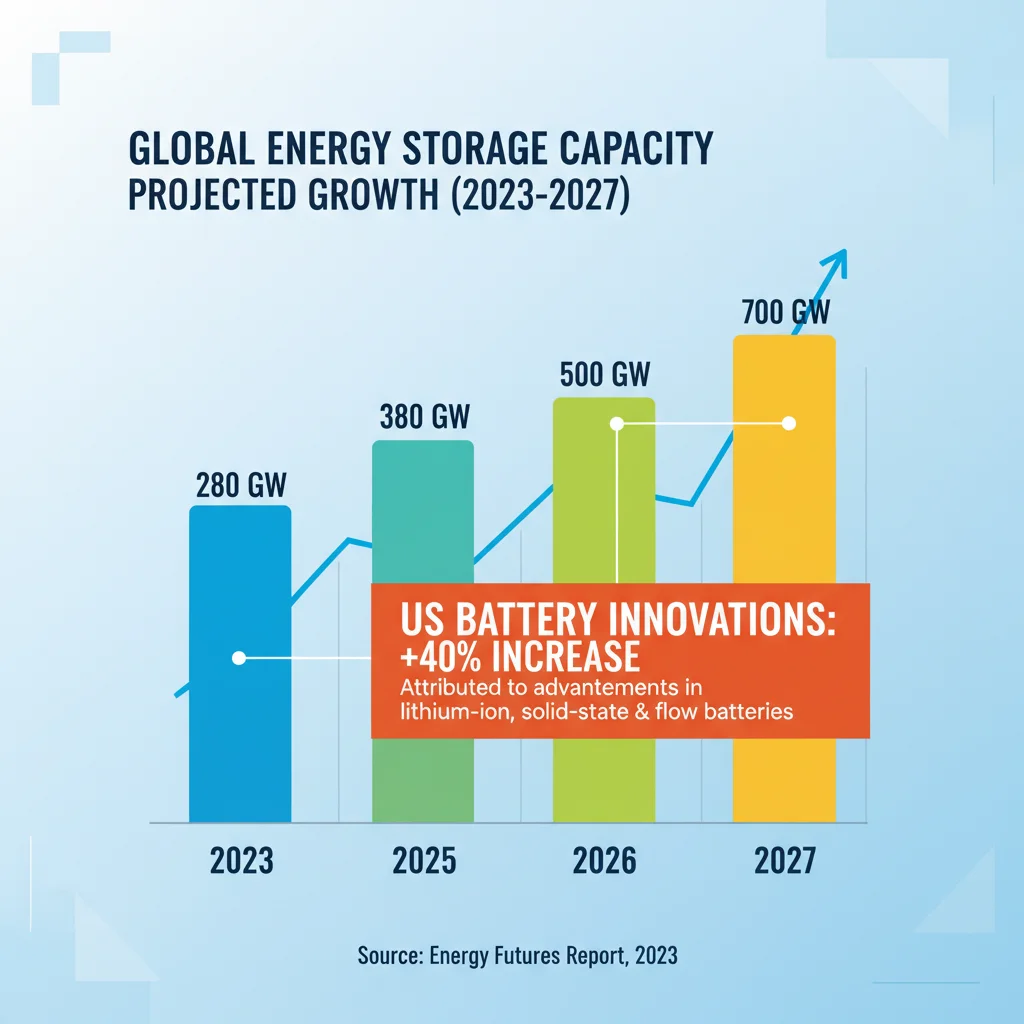
The projected 40% increase in energy storage capacity by 2027, fueled by relentless US battery innovations, marks a pivotal moment in our technological and environmental journey. This isn’t just about incremental improvements; it’s about fundamentally reshaping our energy landscape, making clean energy more reliable, transportation more sustainable, and our economies more resilient.
The confluence of scientific breakthroughs, strategic investments, and a clear vision for an electrified future positions the United States at the forefront of this global transformation. While challenges remain, the momentum is undeniable. The innovations happening today in US labs and factories are laying the groundwork for a future where energy is abundant, clean, and accessible to all. The next few years will be critical, but all signs point to a powerful and positive shift, driven by the remarkable progress in US battery innovations.
Stay tuned as we continue to track these developments, bringing you the latest insights into how these next-gen batteries are powering our world into a brighter, more sustainable tomorrow.