Unlocking Data Mesh Potential: Expert Strategies for US Data Architects to Improve Data Governance by 30% (INSIDER KNOWLEDGE)

In the rapidly evolving landscape of enterprise data, US data architects face unprecedented challenges and opportunities. The sheer volume, velocity, and variety of data continue to grow exponentially, pushing traditional centralized data architectures to their limits. Amidst this complexity, the concept of a data mesh governance model has emerged as a transformative paradigm, promising agility, scalability, and, crucially, enhanced data governance. This comprehensive guide delves into expert strategies, offering insider knowledge for US data architects aiming to unlock the full potential of data mesh and achieve a remarkable 30% improvement in their data governance frameworks.
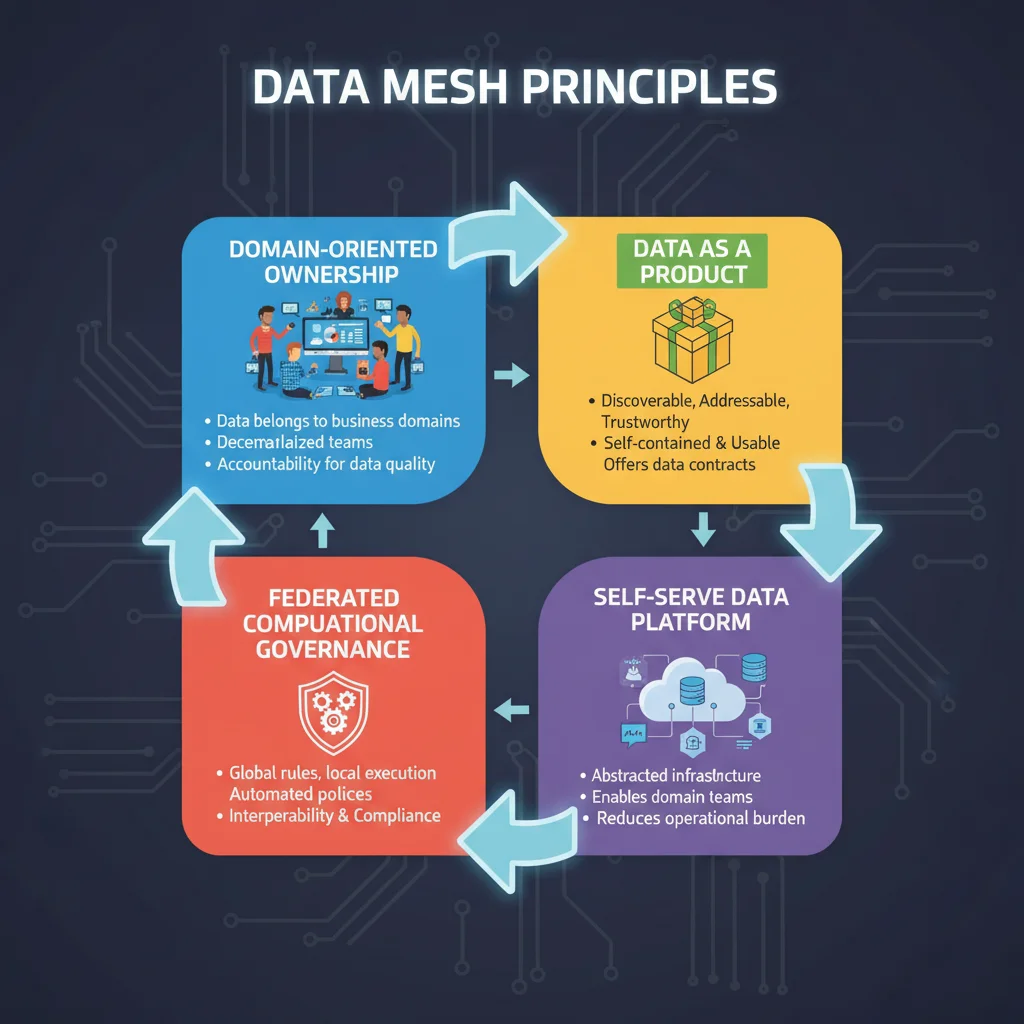
The promise of data mesh is profound: a decentralized approach where data is treated as a product, owned by domain-specific teams, and served through a self-serve data platform, all orchestrated by federated computational governance. While this vision is compelling, its successful implementation, particularly in achieving robust data mesh governance, requires a nuanced understanding and strategic execution. This article will equip you with the insights needed to navigate this journey effectively.
The Imperative for Data Mesh in Modern Enterprises
Before diving into governance specifics, it’s vital to understand why data mesh has become such a critical topic for US data architects. Traditional data warehousing and data lake architectures, while effective for certain use cases, often struggle with:
- Scalability Bottlenecks: Centralized teams become overwhelmed as data sources and consumer demands multiply.
- Data Silos and Lack of Context: Data remains trapped within operational systems, losing business context when moved to a central repository.
- Slow Time-to-Insight: The journey from raw data to actionable insight is often protracted due to multiple handoffs and dependencies.
- Poor Data Quality and Trust: Without clear ownership, data quality suffers, eroding user trust and hindering decision-making.
- Governance Challenges: Enforcing consistent policies across disparate, centrally managed datasets becomes a Herculean task.
Data mesh addresses these pain points by promoting a paradigm shift: decentralizing data ownership and treating data as a product. This fundamental change lays the groundwork for a more agile, scalable, and ultimately, more governable data ecosystem. For US data architects, understanding this foundational shift is the first step towards mastering data mesh governance.
Understanding the Four Pillars of Data Mesh and Their Governance Implications
The data mesh paradigm is built upon four core principles, each with significant implications for data governance:
1. Domain-Oriented Ownership
Instead of a central data team owning all enterprise data, data mesh advocates for domain teams (e.g., Sales, Marketing, Finance, Product Development) to own their operational data and the analytical data products derived from it. This principle is arguably the most radical departure from traditional models and is central to effective data mesh governance.
- Governance Implication: Ownership is distributed, but accountability must remain centralized. This necessitates defining clear roles and responsibilities for data product owners within each domain, including quality, security, and compliance.
- Strategy for US Data Architects: Establish a clear framework for defining domain boundaries and data product ownership. Develop templates for data product contracts and service level agreements (SLAs) that domain teams must adhere to.
2. Data as a Product
Domain teams are responsible for treating their analytical data as a product, meaning it must be discoverable, addressable, trustworthy, self-describing, interoperable, and secure. This transforms data from a raw commodity into a valuable asset with defined characteristics and user expectations.
- Governance Implication: Data quality, metadata management, and discoverability become inherent responsibilities of the domain teams, rather than an afterthought for a central team.
- Strategy for US Data Architects: Implement universal standards for data product documentation, metadata, and quality metrics. Leverage automated tools for data cataloging and discovery to ensure data products meet the ‘discoverable’ and ‘self-describing’ criteria.
3. Self-Serve Data Platform
A foundational platform is needed to enable domain teams to build, deploy, and manage their data products autonomously, without needing deep expertise in underlying infrastructure. This platform provides the necessary tools, infrastructure, and services.
- Governance Implication: The platform must embed governance capabilities by design, providing guardrails and automated policy enforcement, rather than relying solely on manual oversight.
- Strategy for US Data Architects: Design the self-serve platform with built-in governance features: access control, lineage tracking, auditing, and policy enforcement. Provide standardized templates and tools that guide domain teams towards compliant data product creation.
4. Federated Computational Governance
This principle acknowledges that while ownership is distributed, a central body is still required to define and enforce global policies, standards, and interoperability protocols. However, this governance body operates in a federated manner, involving representatives from various domains and leveraging automation (computational) to enforce policies.
- Governance Implication: This is where the core of data mesh governance resides. It’s about balancing autonomy with coherence, enabling domains to innovate while ensuring enterprise-wide consistency and compliance.
- Strategy for US Data Architects: Establish a Federated Governance Council with clear representation from data owners, consumers, legal, and security. Prioritize the automation of governance policies through code and platform capabilities.
Insider Strategies for US Data Architects to Elevate Data Mesh Governance
Achieving a 30% improvement in data governance through data mesh isn’t merely about adopting the principles; it’s about strategic implementation. Here are actionable, insider strategies:
Strategy 1: Cultivate a Strong Data Culture and Literacy
The success of distributed ownership hinges on the data literacy of domain teams. If data product owners don’t understand the importance of metadata, quality, or compliance, governance will fail.
- Actionable Insight: Launch a comprehensive data literacy program across all domain teams. This should cover data fundamentals, governance best practices, and the specifics of treating data as a product. Emphasize the ‘why’ behind governance – not just compliance, but enabling better business outcomes.
- Impact on Governance: Reduces errors at the source, increases proactive adherence to policies, and fosters a shared responsibility for data quality and trust. When domain teams understand their role, the burden on central governance is significantly reduced.
Strategy 2: Implement a Robust Data Product Contract Standard
For data products to be truly interoperable and trustworthy, they need well-defined contracts that specify their schema, semantics, quality expectations, and access policies.
- Actionable Insight: Develop a standardized data product contract template that all domain teams must use. This contract should detail schema definition (e.g., Avro, Protobuf), data types, semantic meaning of fields, data quality metrics (e.g., freshness, completeness, accuracy), service level objectives (SLOs) for availability, and clear access control mechanisms. Automate the validation of these contracts.
- Impact on Governance: Ensures consistency and predictability across the mesh, making it easier to enforce policies related to data quality, security, and compliance. It also facilitates automated data lineage and impact analysis.
Strategy 3: Prioritize Federated Computational Governance with Automation
Manual governance in a data mesh is a recipe for failure. Leverage technology to embed governance into the fabric of the self-serve platform.
- Actionable Insight: Design the self-serve data platform to include automated checks and balances. This means integrating tools for schema validation, data quality monitoring (with automated alerts), access policy enforcement (e.g., using attribute-based access control – ABAC), and automated auditing/logging of data product usage. Utilize policy-as-code principles where governance rules are defined and enforced programmatically.
- Impact on Governance: Drastically reduces manual overhead, ensures consistent policy application, provides real-time visibility into compliance, and allows the Federated Governance Council to focus on strategic policy-making rather than day-to-day enforcement.
Strategy 4: Establish Clear Accountability and Escalation Paths
Distributed ownership requires distributed accountability, but also a clear mechanism for resolving disputes or non-compliance issues.
- Actionable Insight: Define explicit roles and responsibilities for data product owners, data stewards (within domains), and the central Federated Governance Council. Create a documented escalation process for data quality issues, policy violations, or data product contract disputes. This ensures that problems are addressed promptly and effectively.
- Impact on Governance: Prevents governance gaps, ensures timely resolution of issues, and reinforces the importance of data stewardship across the organization.
Strategy 5: Implement Comprehensive Metadata Management and Data Cataloging
For a data mesh to be truly self-serve, data products must be easily discoverable and understandable. Rich, accurate metadata is crucial.
- Actionable Insight: Invest in a robust, enterprise-wide data catalog that automatically ingests metadata from data products. This catalog should support both technical metadata (schema, lineage) and business metadata (definitions, ownership, quality scores, usage statistics). Encourage domain teams to enrich their data products with comprehensive business descriptions.
- Impact on Governance: Improves data discoverability, enhances data literacy, facilitates impact analysis for changes, and provides a central point of truth for governance information, directly supporting the ‘data as a product’ principle.
Strategy 6: Define and Monitor Key Data Governance Metrics
To improve governance by 30%, you need to measure it. Define specific, measurable, achievable, relevant, and time-bound (SMART) metrics.
- Actionable Insight: Establish KPIs for data quality (e.g., completeness, accuracy, freshness), compliance (e.g., number of policy violations, data access request fulfillment time), data product adoption, and metadata completeness. Implement dashboards to track these metrics across all data domains and report them regularly to the Federated Governance Council and executive leadership.
- Impact on Governance: Provides objective evidence of governance effectiveness, identifies areas for improvement, justifies resource allocation, and demonstrates tangible progress towards the 30% improvement goal.
Strategy 7: Foster a Culture of Continuous Improvement and Feedback Loops
Data mesh governance is not a one-time setup; it’s an iterative process.
- Actionable Insight: Implement regular review cycles for governance policies and data product contracts. Encourage feedback from data product owners and consumers to refine processes and tools. Establish a ‘community of practice’ for data product owners to share best practices and challenges.
- Impact on Governance: Ensures governance policies remain relevant and effective, promotes adaptiveness to changing business needs, and continuously strengthens the data mesh governance framework.

Overcoming Challenges in Data Mesh Governance for US Data Architects
While the benefits are clear, implementing effective data mesh governance isn’t without its hurdles. US data architects must be prepared to address:
Organizational Resistance to Change
Moving from a centralized to a decentralized model can be met with skepticism from those accustomed to traditional structures. Domain teams may resist the added responsibility of data product ownership, while central IT may fear losing control.
- Solution: Emphasize the benefits to each stakeholder group. For domain teams, highlight increased autonomy and faster time-to-market for data. For central IT, stress the shift from operational burden to strategic enablement and platform provision. Secure executive sponsorship and communicate the vision clearly and consistently. Pilot projects can demonstrate early successes.
Complexity of Tooling and Platform Implementation
Building a robust self-serve data platform with embedded governance capabilities requires significant technical expertise and investment.
- Solution: Start with a minimal viable platform (MVP) that addresses critical needs and gradually expand capabilities. Leverage open-source tools and cloud-native services where possible to accelerate development. Focus on providing standardized, easy-to-use interfaces for domain teams.
Ensuring Interoperability Across Diverse Data Products
With data spread across domains, ensuring that different data products can be seamlessly combined and analyzed is crucial.
- Solution: Strict adherence to data product contract standards, especially concerning schema definition and semantic consistency, is paramount. Invest in a robust data catalog that supports semantic metadata. Promote the use of common data models or ontologies where appropriate.
Balancing Autonomy with Centralized Control
The core tension in data mesh is the balance between domain autonomy and enterprise-wide coherence. Too much autonomy can lead to chaos; too much central control can stifle innovation.
- Solution: The Federated Governance Council plays a critical role here. It must act as an enabler, setting guardrails rather than dictating every detail. Focus on defining global policies for non-negotiables (e.g., security, privacy, compliance) while giving domains flexibility in how they implement these within their data products.
Measuring the 30% Improvement in Data Governance
To quantify the 30% improvement, US data architects need to establish a baseline before data mesh implementation and then track progress against it. Key metrics for measuring success in data mesh governance include:
- Data Quality Scores: Track metrics like data freshness, completeness, accuracy, and consistency across critical data products. A 30% improvement could mean reducing data errors by 30%, or increasing the percentage of data products meeting defined quality thresholds by 30%.
- Compliance Adherence Rate: Monitor the number of data products that fully comply with regulatory requirements (e.g., GDPR, CCPA, HIPAA) and internal policies. Aim to reduce compliance violations by 30%.
- Time-to-Insight/Data Availability: Measure the time it takes for new data sources to become available as trusted, governed data products. A 30% reduction indicates improved agility.
- Data Discoverability Score: Assess how easily users can find and understand relevant data products through the data catalog. This can be measured by user feedback, search success rates, or the completeness of metadata.
- User Trust in Data: Conduct surveys or track usage patterns to gauge user confidence in the accuracy and reliability of data products. An increase in data product consumption and a decrease in data-related disputes would be positive indicators.
- Cost of Data Governance: While governance is an investment, efficient data mesh governance can lead to reduced costs associated with manual data cleaning, compliance audits, and data-related incidents.
By diligently tracking these metrics and continuously refining your data mesh governance strategies, US data architects can tangibly demonstrate the value and effectiveness of their data mesh implementation.
The Future of Data Governance with Data Mesh
The journey towards a fully mature data mesh governance model is continuous. As technology evolves and business needs change, so too will the requirements for data governance. US data architects are at the forefront of this evolution, shaping how organizations manage and leverage their most valuable asset – data.
Embracing data mesh is not just about adopting a new architecture; it’s about fostering a new mindset around data. It’s about empowering domain teams, promoting data ownership, and embedding governance into every facet of the data lifecycle. The strategies outlined in this article provide a robust roadmap for achieving significant improvements in data governance, ultimately leading to more trustworthy data, faster insights, and a more agile, data-driven enterprise.
By meticulously planning, implementing, and continuously improving their data mesh governance framework, US data architects can confidently lead their organizations into a future where data is truly a strategic advantage, capable of driving innovation and informed decision-making at every level.